
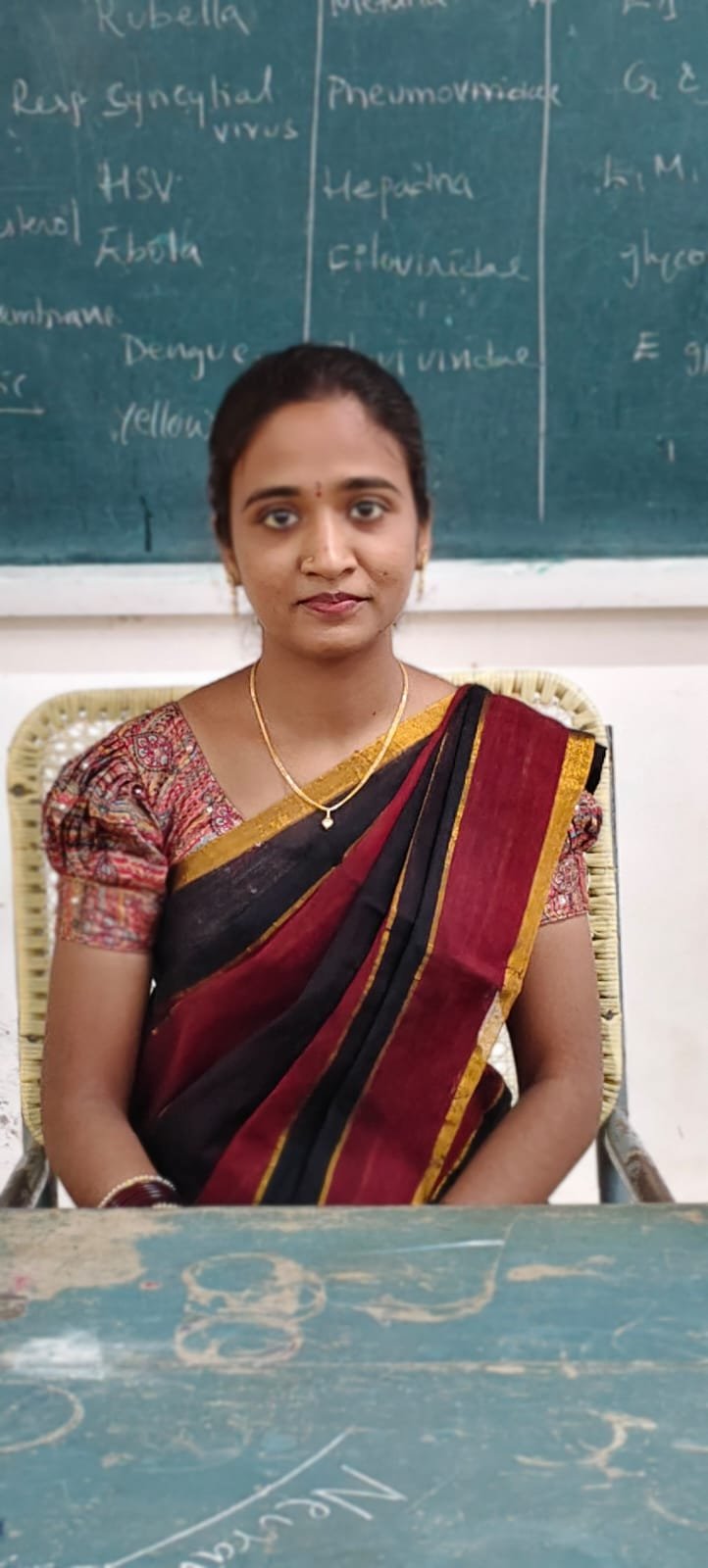
Biology/microbiology
Cellularmicrobiology
Avaialbe For Home Tutoring
Available For Online Tutoring
Total Exp : 0 - 2 Years
Reg. On : 2nd, November 2026
I hold an MSc in Microbiology and a BSc in Aquaculture. I have 6 months of school teaching experience and currently work as a assistant professor at Vignan College, teaching Cellular Eukaryotic Micro Read More..
bes and Agriculture to BSc and MSc students. I also have hands-on laboratory experience and previous industry experience in Quality Control (QC). My teaching methods include concept-based learning, simple explanations, diagrams, PowerPoint presentations, practical demonstrations, and interactive discussions. I focus on understanding each student's learning needs, encouraging questions, clearing doubts, and conducting regular revisions to make learning interesting, effective, and easy to understand.
Replies within an hour
Guntur
I am online
300 Per Hour
3.16 Per Hour

Microbiology
Available For Online Tutoring
Total Exp : 5 - 10 Years
Reg. On : 1st, April 2026
I am Er. Shreya Jain, a dedicated and passionate educator with 7+ years of teaching experience in guiding students from primary to senior secondary levels. I have completed my M.Tech in Biomedical Eng Read More..
ineering from Delhi Technological University (DTU), which has given me a strong academic foundation in Science, Biology, Mathematics, and analytical learning.
I provide All Subjects tuition from Classes 1 to 7, and for Classes 8 to 12, I specialize in Science, Biology, and Mathematics with a strong focus on concept clarity, regular practice, and confidence building. I also guide students for competitive exams such as NEET, GATE (Biotechnology), and UGC NET Life Sciences, which reflects my depth of subject knowledge and academic strength.
My teaching methodology is student-friendly, interactive, and personalized according to each learner’s pace and needs. I believe every student can perform well when taught with patience, clarity, and the right strategy. My classes are designed to make learning simple, engaging, and result-oriented. I focus on:
Strong fundamentals
Concept-based learning
Doubt solving
Regular revision and practice
Worksheet and test support
Confidence building for exams and school performance
Achievements / Strengths
7+ years of successful teaching experience
M.Tech in Biomedical Engineering from DTU
Strong expertise in Biology, Science, and Mathematics
Experience teaching students across multiple boards and levels
Guidance for NEET, GATE (Biotechnology), and UGC NET Life Sciences
Known for creating a comfortable, motivating, and disciplined learning environment
My goal is not just to help students score better, but to help them become independent, confident learners who truly understand what they study. I am committed to supporting students with patience, consistency, and a clear teaching approach that makes learning easier and more enjoyable.
Replies within an hour
I am online
300 Per Hour
3.16 Per Hour

Microbiology
Avaialbe For Home Tutoring
Available For Online Tutoring
Total Exp : 5 - 10 Years
Reg. On : 11th, October 2025
1. Lecture Method with Visual Aids Offline: Use whiteboards, projectors, charts, or models. Online: Use slides with diagrams, flowcharts, and animations via platforms like Zoom or Google Meet. Read More..
Tip: Keep lectures interactive with questions after each concept.
2. Concept Mapping & Flowcharts
Encourage students to draw concept maps for complex topics like microbial metabolism, genetic engineering, or immune responses.
Tools: MindMeister, Lucidchart, or pen-paper (offline).
Helps students understand and retain interlinked concepts
Replies within an hour
Kolkata
Offline
200 Per Hour
2.11 Per Hour
Post Requirement
Revealing the Unseen World: Microbiology Under Your Teacher Mitra!
From the food we eat to the air we breathe and even our own health, ever wondered about the small, invisible organisms that affect every element of our life? Driven to know their roles in disease, biotechnology, or environmental cycles, are you enthralled by bacteria, viruses, fungi, and protists? Alternatively you might be working on a difficult university course and need a guiding hand to negotiate this microscopic boundary. Whichever your ambition, welcome Tutor Mitra, your ideal partner in learning the vital and fascinating field of microbiology. Your trip into the amazing world of microorganisms starts right here with a committed Microbiology Tutor!
Why is microbiology? The Science of Smallest Powerhouses in Life
Microbiology is the scientific study of microscopic organisms, entities so small they are invisible to the unaided eye; it is not only about germs. From infectious diseases and food production to drug development, environmental cleanup, and even global climate shaping, these little powerhouses—bacteria, viruses, fungi, algae, protozoa—have enormous roles in everything. It's the science of the smallest yet most powerful participants in life! And really, the correct Microbiology Tutor can shine light on these invisible worlds, rendering them both logical and ceaselessly motivating.
My "Aha!" flashpoint: Penicillin's Story
The sheer count of bacterial species used to overwhelm me. Then my lecturer related the tale of Alexander Fleming and the unintentional penicillin discovery. A forgotten petri dish, a mold contamination, and a zone of inhibition around it—a small, undetectable war being battled right there. It was a revelation rather than only a discovery—that these invisible creatures held keys to healing. That moment demonstrated the power of a relevant Microbiology Tutor and really confirmed my enthusiasm by tying tiny life to enormous human influence.
Examining Microbiology: Why Is It Such Powerful and Common?
A wonderfully broad and multidisciplinary field is microbiology. It calls on elements of molecular biology, genetics, immunology, biochemistry, ecology, and even public health. This broad perspective ensures that you are learning about basic biological processes and their practical consequences rather than only about small organisms. Your Microbiology Tutor will guide you across these linked fields, so developing a thorough and useful knowledge base.
The main players are These are the microorganisms?
Let us introduce the key players of the microbial universe:
Single-celled prokaryotes—no nucleus—bacteria They are quite varied and take many different forms—rods, spheres, spirals. Some cause disease; others are either necessary for digestion or nutrient cycling. Their unusual cell structures can be clarified by your microbiologist tutor.
Archaea: Also single-celled prokaryotes, but not exactly like bacteria genetically. Often found in hot springs and deep sea vents, these are actual extremophiles—extreme environments!
Like yeasts, molds, and mushrooms, eukaryotes—have a nucleus! Important decomposers, sources of antibiotics, and some start infections. Consider the yeast in beer or the bread mold!
Diverse group of eukaryotic microorganisms, protists include protozoa (like amoebas) and algae (like pond scum). They are rather important for ecology.
Viruses: The best argument ever created! Live or dead? These non-cellular entities need a host if they are to replicate. Masters of hijacking cellular machinery are they Your Microbiologist Tutor will go over their unusual structures and life cycles.
Fundamental to microbiology is knowledge of the fundamental traits of every group.
Fundamental Ideas: Building Blocks of Microbial Life
Microbiology is based on a few fundamental ideas that apply everywhere:
Microbial Growth and Nutrition: What Drives Their Thrive—or Not?
Microbes flourish in particular environments. Cultivating them, preventing spoilage, or stopping disease depends on an awareness of their nutritional needs (carbon, nitrogen, energy sources) and environmental factors (temperature, pH, oxygen levels).
Culture Media: The particular nutrient solutions applied in a lab to cultivate bacteria.
Growth Curve: Lag, log, stationary, death phases—how microbial populations change with time?
Your Microbiologist will demonstrate to you how both good and negative microbial activity depend on the control of these variables.
Microbial Metabolicism: Little Manufacturing Plants
Microbes are molecular powerhouses! To get energy and assemble cellular components, they engage an amazing range of metabolic reactions.
Anaerobic vs. Aerobic Respiration: How either with or without oxygen do bacteria create energy?
Fermentation is the metabolic process by which many bacteria—such as those in yogurt or bread—as well as yeast transform sugars into acids, gases, or alcohol.
Biotechnology, food manufacture, and drug action all depend on an awareness of metabolism.
Microbial Genetics: The Manual of Life
Masters of genetic creativity, microbes evolve quickly and share genetic material.
DNA and RNA are the genetic tools carrying directions.
Protein synthesis: How genetic data is applied?
Mutation in DNA that might produce novel features.
Horizontal gene transfer—conjugation, transformation, transduction—allows bacteria to directly share genes, so promoting fast spread of antibiotic resistance!
Your Microbiology Tutor will walk over these mechanisms, stressing how they affect antibiotic resistance and evolution.
Immunology: Our Body's Defense Mechanisms
Much of microbiology is about learning how our bodies fight off bacterial invaders.
The complicated network of organs, tissues, and cells that guards us is our immune system.
Innate versus adaptive immunity: The body's instantaneous, non-specific defenses against particular, memory-based reactions.
Vaccines: How we teach our immune system to fight upcoming infections using weakened or inactivated bacteria—or parts of them?
Your Microbiologist will guide you across the interesting realm of antigens, antibodies, and immune cells.
Microbial Ecology: The Silent Universe of Interactions
Microbes interact with their surroundings and other organisms; they create complex communities rather than existing in a vacuum.
Microbiome: The assembly of every microorganism inhabiting a given habitat (e.g., the human gut microbiome, soil microbiome).
Microbes are fundamental for cycling nutrients including carbon, nitrogen, and sulfur across ecosystems. They are the outstanding recyclers.
Bioremediation is environmental pollution cleanup by means of microorganisms.
Knowing microbial ecology helps one to see their vital importance for planetary health.
Uses: Where Microbiologist shines
The influence of microbiology is great and affects practically all element of our life:
Medicine: Creating vaccines, antibiotics, tests, knowledge of infectious diseases.
Food Industry: Food safety; food preservation; fermentation (bread, cheese, yogurt, beer).
Agriculture: Fertilizer, plant disease control, nitrogen fixation.
Making enzymes, drugs (like insulin), biofuels, and biomaterials is biotechnology.
Environmental science includes pollution control, wastewater treatment, and study of climate change.
These microscopic creatures have absolutely infinite possibilities.
Why Choose a Microbiologist Tutor from Mitra?
Our great passion at Tutor Mitra is the invisible world of microorganisms and their enormous influence. Highly seasoned teachers with many advanced degrees (M.Sc., Ph.D.), many with practical experience in academic, clinical, or industrial microbiology make up our Microbiology Tutor team. They appreciate the complexity of the topic and, most importantly, know how to make it interesting, approachable, and really motivating for students from all backgrounds and objectives.
Whether you're a professional looking to further your knowledge, a university student working on advanced virology or immunology, or a high school student considering a career in health sciences, we provide customized lesson plans exactly tailored to your needs. Our teachers bring the topic to life with a narrative approach, real-world examples—such as the most recent headlines on pandemics or microbial discoveries—and clear explanations. They are utterly committed to your success, patient, and motivating. Using a Tutor Mitra Microbiology Tutor, you are developing critical thinking skills to grasp, evaluate, and help to preserve the health and well-being of our planet, not only learning about microscopic creatures.
All set to discover the invisible universe influencing our outward one? Get in touch with Tutor Mitra right now to enable us to match you with the ideal Microbiologist. Your amazing trip into the smallest universe is just waiting!