Beti Bachao Beti Padhao - A Nation Half Unborn
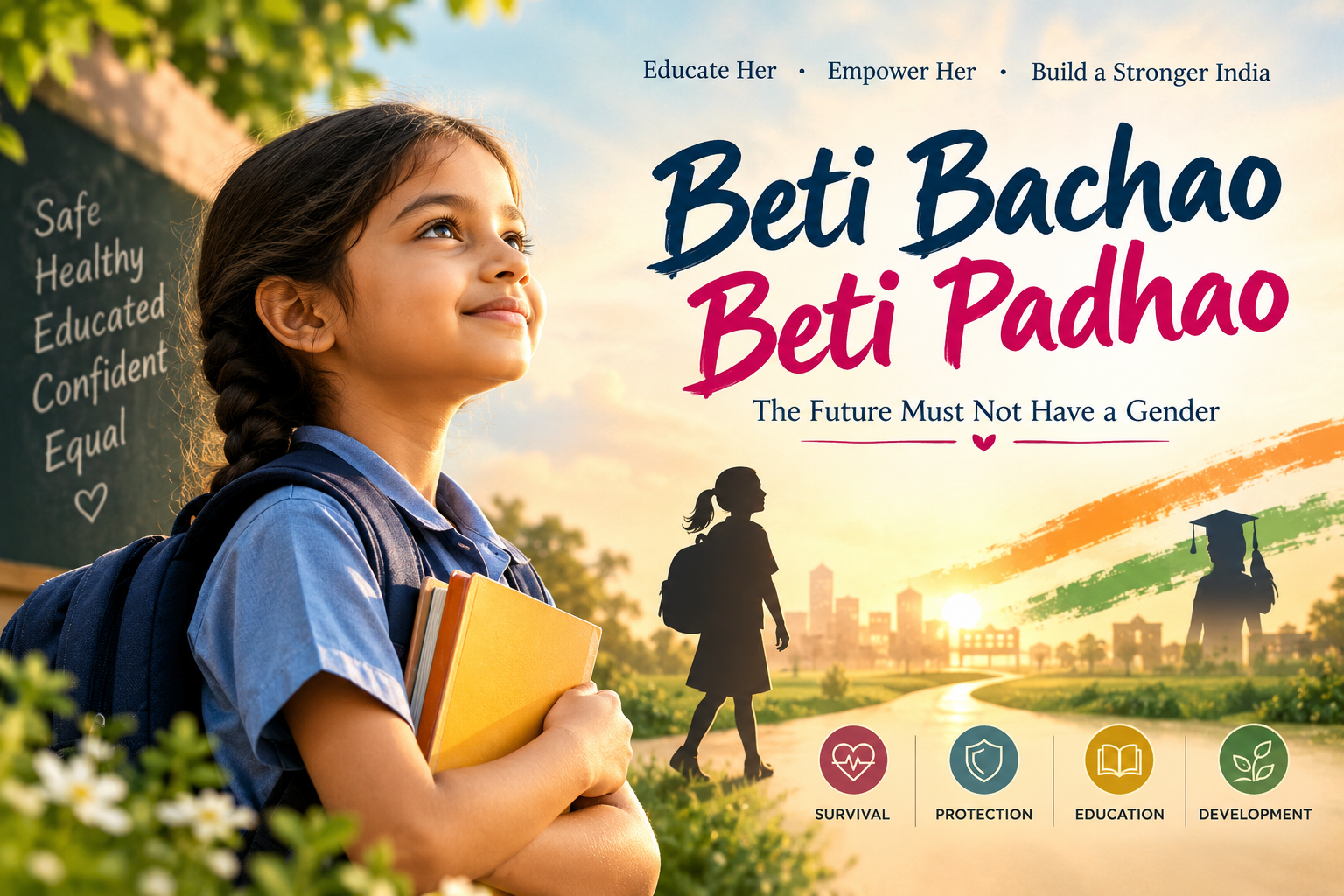
Beti Bachao Beti Padhao - A Nation Half Unborn
A country’s conscience is revealed not only by the monuments it builds, but by the children it allows to dream. Imagine a girl standing at a classroom door: her books are ready, her questions are alive, yet the world has already written a smaller future for her.
Beti Bachao Beti Padhao began as a national response to this injustice. Launched on 22 January 2015 in Panipat, Haryana, it addresses the declining child sex ratio and seeks the survival, protection, education and development of girls.
The silence behind the numbers
A preference for sons can hide in familiar questions: “Who will carry the family name?” or “Who will look after us in old age?” Discrimination is not always announced loudly; sometimes it hides inside ordinary habits.
The 2011 Census recorded 918 girls for every 1,000 boys in India’s 0–6 age group. In February 2026, the government reported that the national sex ratio at birth rose from 918 in 2014–15 to 929 in 2024–25. It also reported that girls’ gross enrolment ratio at secondary level rose from 75.51% to 80.2% over that period.
What the scheme actually does
The scheme aims to prevent gender-biased sex selection, improve girls’ survival and protection, support education and change public attitudes. Activities include awareness campaigns, community mobilisation and coordination among departments responsible for health, education and women’s and child development. Its priorities include improving sex ratio at birth, encouraging institutional deliveries, increasing early antenatal registration, raising girls’ secondary-school enrolment, reducing dropouts and promoting safe menstrual hygiene.
She needs healthcare and nourishment before school; during adolescence, she needs accurate information, sanitation, safety and teachers who take her ambitions seriously. Support matters when these stages connect.
An important truth: it is not a cash-transfer scheme
One misunderstanding deserves attention: Beti Bachao Beti Padhao does not provide individual cash payments or direct benefit transfers to families. The Ministry explicitly confirms there is no DBT provision. The programme promotes social and behavioural change; it is not a savings account or scholarship application. The Ministry has also warned about fake forms falsely promising money in the scheme’s name.
If a form, agent or message promises guaranteed cash in exchange for registration fees, personal documents or bank details, pause and verify it through official government channels. Families seeking educational financial support should check the rules of the relevant scholarship separately; BBBP does not make other benefits automatic.
Education is more than enrolment
A girl is not truly educated simply because her name appears on a school register.
Teachers can notice repeated absences without blaming the child, challenge sexist jokes, make classrooms safe and encourage girls to study science, literature, mathematics, sport or any field that interests them. Menstrual hygiene should be ordinary health education, not a source of shame.
Boys belong in this change, too. Respect is not a favour offered to girls; it is a basic condition of living together. Society changes when sons learn to share care, listen without mockery and recognise women as equals.
Women important: a principle, not a slogan
The phrase women important may sound grammatically unusual, but its meaning is urgent: women are important—not merely as symbols, mothers or daughters, and not because they may serve someone else.
Educating girls can benefit families and communities through greater knowledge, participation and economic opportunity. Yet a girl’s worth should never depend on how much she earns, whom she cares for or how useful others find her. She deserves safety and education because she is human.
Empowerment should not be reduced to photographs of successful women. Notice, too, the girl who travels far to school, the student who needs extra help, the young woman whose education is interrupted by poverty, and the child whose dreams are dismissed because of gender. Progress means not only how high one woman rises, but how many barriers no longer stand in another’s way.
What citizens can do
The campaign becomes real through ordinary choices:
Reject sex-based discrimination in family decisions, healthcare and education.
Keep girls in school and respond early when attendance drops.
Share domestic responsibilities among children instead of assigning them by gender.
Verify government-benefit claims on official websites and report misleading promises.
Support safe schools, clean toilets, menstrual-health awareness and equal opportunities in study and sport.
Praise girls for curiosity, courage, kindness and effort—not merely obedience.
Families can begin locally: ask schools about attendance, learning support, toilets and safe travel; ask health workers about services; and consult district officials for verified campaign information. Judge local action by outcomes, not banners.
Are girls staying in school? Do parents receive accurate information? Can a girl speak without fear? Such questions turn a national message into accountability. Its strength is making discrimination visible and encouraging institutions to work together, while citizens insist that promises become everyday practice.
The future is not a favour
India can celebrate daughters in speeches while limiting them in daily life. The campaign’s success cannot be judged by posters alone. The National Portal of India describes the campaign as an effort to ensure girls are born, nurtured and educated without discrimination.
That is the heart of its promise. A scheme can raise awareness and coordinate action, but families, schools, institutions and citizens must carry its values into practice. Perhaps the most meaningful tribute to a daughter is not a grand ceremony on one day. It is a home where her questions are heard, a school where her potential is nurtured, and a society where her ambitions need no apology.
Save the girl. Educate the girl. Then make room for the woman she chooses to become.
Online and home tutors for 2,700+ subjects. Book a free trial class today. tutormitra.com →