Fast Radio Burst News — When Eternity Clears Its Throat
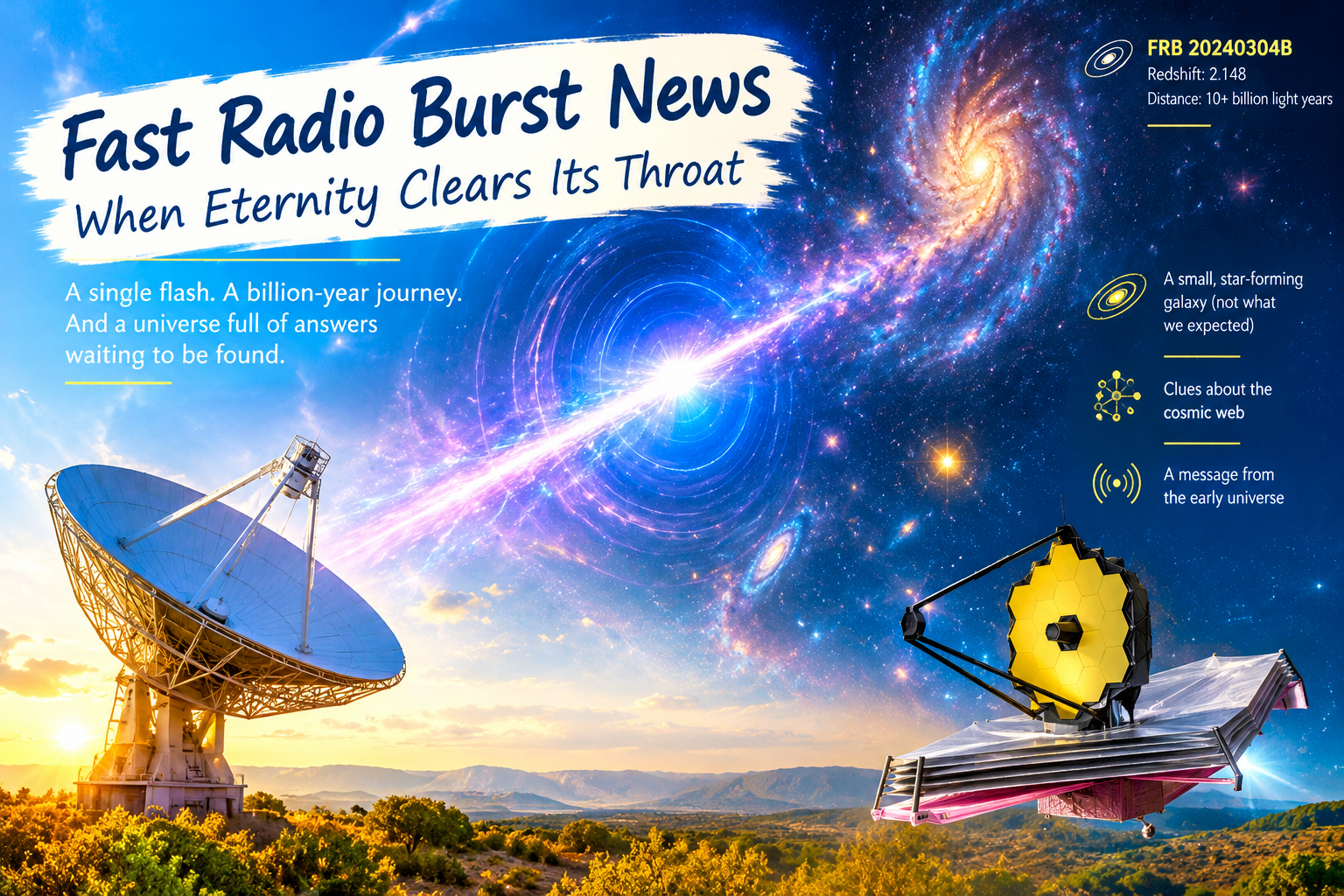
Somewhere beyond the familiar stars, the universe speaks in a language of radio waves. We have learnt to hear it. We are only beginning to understand what it says.
Imagine receiving a message that has travelled across the universe for billions of years. It arrives, makes itself known for a fraction of a second, and disappears before you can properly ask who sent it.
No farewell. No explanation. Not even a second chance.
Astronomers call such events Fast Radio Bursts (FRBs). They are among the most intriguing phenomena in modern astronomy: extraordinarily brief flashes of radio waves that can release enormous amounts of energy in an instant.
Now, a distant burst has brought a remarkable scientific achievement into focus. Using the James Webb Space Telescope, astronomers have investigated the environment of the farthest fast radio burst yet reported in the research highlighted by NASA and Science.
The discovery is not simply about finding something far away. It is about learning how to read a message whose journey began when the universe was much younger.
A Flash from the Universe’s Childhood
The burst, named FRB 20240304B, was detected on 4 March 2024 by the MeerTRAP team using South Africa’s MeerKAT radio telescope. Its name may look like an entry in a bureaucratic register, but its journey is anything but ordinary. The signal travelled for more than 10 billion years before reaching Earth.
Here is the extraordinary part: when this burst occurred, the universe was only about three billion years old. In other words, we are receiving evidence from a time when the cosmos was still in its youth.
The James Webb Space Telescope (JWST) helped researchers identify the galaxy associated with the burst and measure its redshift at 2.148. Redshift is the stretching of light towards longer wavelengths as the universe expands. It allows astronomers to investigate how far back in cosmic history an object belongs.
A flash lasting milliseconds has therefore become a messenger from a universe billions of years younger than our own.
The Galaxy That Defied Expectations
Astronomers might have expected the burst to come from a large, well-developed galaxy. Instead, Webb revealed a small dwarf galaxy actively forming stars.
NASA reports that this host galaxy was around 1,000 times less massive than researchers expected. It existed during an era known as cosmic noon, when star formation across the universe was near its peak. The galaxy’s star-formation rate suggests that most of its stars may have formed within only 30 million years.
Think about the contrast. A relatively small galaxy, not a grand collection of stars, produced a signal powerful enough for our instruments to detect across immense cosmic distances.
This discovery matters because a galaxy is not merely a backdrop. Its age, chemical composition and star-forming activity provide clues about the kinds of objects that might produce FRBs.
The unexpected birthplace has forced astronomers to reconsider which cosmic environments can produce these mysterious flashes.
What Could Make a Star Shout?
We know that FRBs are brief bursts of radio emission. We do not yet know their complete origin story.
Two leading explanations involve neutron stars, the extremely dense remnants left behind by certain stellar explosions.
* Magnetars: These neutron stars possess extraordinarily powerful magnetic fields. Changes in their surroundings or sudden rearrangements in their crusts could trigger bursts of radiation.
* Neutron-star mergers: Two neutron stars may eventually collide after orbiting one another for a very long time, producing energetic events.
The young, actively star-forming host galaxy offers an important clue. A magnetar could form relatively soon after a massive star explodes, making it a plausible source in a young galaxy. By contrast, a neutron-star merger may require a much longer delay. The research therefore suggests that a merger is unlikely to explain this particular burst. It does not, however, establish a single origin for every FRB.
Science sometimes advances not by finding a final answer, but by discovering which answers fit the evidence less comfortably.
The Extraordinary Discovery Between Us and the Burst
Here is the detail that deserves far more attention: the signal tells us about more than the galaxy that produced it. It also reveals structures along its journey.
As radio waves cross space, they encounter matter that cannot always be seen directly. That matter leaves an imprint on the signal. By studying the burst, astronomers can investigate the otherwise difficult-to-observe cosmic web of matter between galaxies.
In this case, researchers identified evidence of two structures along the signal’s path: a previously unknown galaxy cluster at redshift 0.3 and the nearby Virgo Cluster, approximately 54 million light-years from Earth.
This opens an exciting possibility. A fast radio burst can act like a cosmic flashlight, helping researchers map material that ordinary images may not reveal clearly.
Imagine trying to understand a dark road by examining how a beam of light changes as it passes through the mist. FRBs offer astronomers a different, more indirect version of that opportunity on a cosmic scale.
The flash is gone, but its journey leaves evidence behind.
Why Webb and MeerKAT Make Such a Powerful Team
MeerKAT detects the radio signal and helps determine its position. Webb then examines the relevant patch of sky in infrared light, identifying the faint host galaxy and measuring its redshift with its spectroscopic instruments.
Neither instrument performs the entire investigation alone. One catches the brief announcement; the other helps identify its birthplace.
This combination could help researchers study more distant bursts and their host galaxies. NASA reports that MeerKAT may detect and localise several FRBs each year at redshifts above 1, while Webb can help characterise their galaxies.
The importance extends beyond breaking a distance record. Each well-localised burst can provide another sample of the universe’s history and the matter scattered throughout it.
The Mystery Remains
We should resist the temptation to call every unexplained signal evidence of extraterrestrial intelligence. FRBs are fascinating precisely because the physical mechanisms behind them remain under investigation.
This discovery does not prove that all bursts originate from magnetars, nor does it solve every question about their behaviour. Instead, it offers a new piece of evidence: a distant burst, an unexpectedly small host galaxy and a signal marked by structures encountered along the way.
Perhaps that is the real wonder of astronomy. The universe does not always reveal its secrets in grand spectacles. Sometimes it offers a whisper, and waits billions of years for someone capable of listening.
When eternity clears its throat, even a millisecond can change the questions we ask about the cosmos.
Online and home tutors for 2,700+ subjects. Book a free trial class today. tutormitra.com →