Flow AI – Sailing on the Sea of Imagination
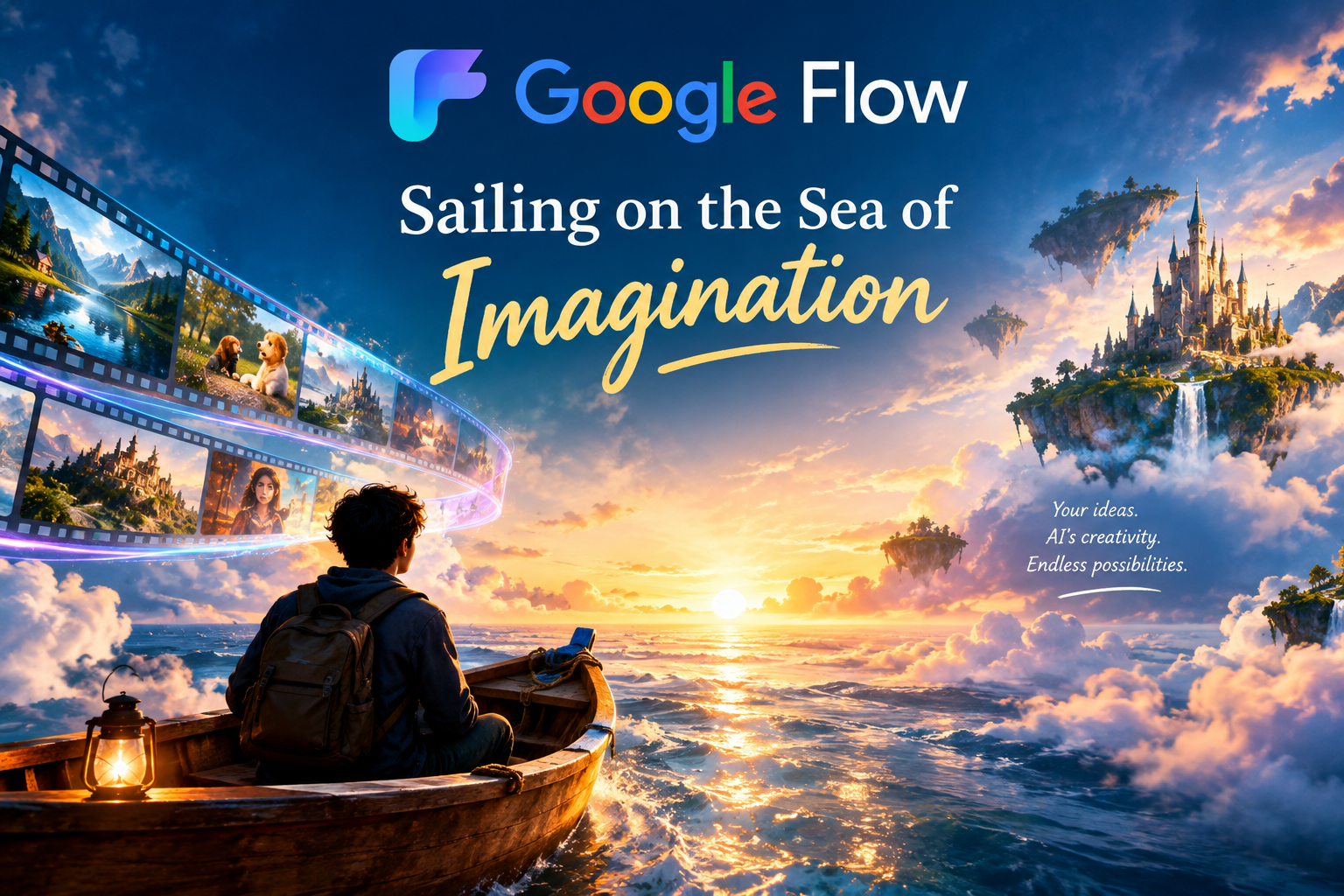
Flow AI – Sailing on the Sea of Imagination
What happens when a simple thought learns to move, speak, and become a world of its own?
There was once a time when making a film required a camera, actors, a location, a patient director, and enough money to make a sensible person abandon the idea. Then came the computer, which made certain things easier, though it did not make everybody a filmmaker. Now comes artificial intelligence, carrying a rather curious promise: tell it what you imagine, and watch your imagination begin to take shape.
This is where Google Flow AI enters the story.
Available through Google Flow . Flow is an AI-powered creative studio designed to help people turn ideas into images, video clips, scenes, and stories. It brings together Google's generative AI models and creative tools in one workspace.
And, as I have observed, the most extraordinary adventures sometimes begin with a perfectly ordinary person having an unreasonable idea.
What Is Google Flow AI?
Google Flow AI is a filmmaking and visual-creation tool that helps you create scenes by describing what you want to see. You do not necessarily need a camera, a film crew, or professional editing experience to begin. You need an idea, a little patience, and the ability to explain that idea clearly.
Flow uses models including Veo for video generation, Nano Banana for image creation and editing, and Gemini to support creative planning and workflows. The available models and features can vary by subscription, platform, and region.
Imagine writing:
A lonely railway station in the Indian countryside at sunrise. An old man waits beneath a yellow lamp while mist moves slowly across the tracks. Cinematic lighting, realistic details, a gentle camera movement.
Instead of leaving these words upon the page, you can use them as instructions for generating a visual scene. The machine attempts to translate your description into something you can see.
The difference is rather like the difference between telling a friend about a dream and showing that friend a moving picture of it.
But remember, Flow is not a magic wand. The results depend on your instructions, the model you choose, and the limits of the technology. Sometimes the machine understands beautifully. Sometimes it misunderstands the confidence of a very proud uncle.
Sailing from an Idea to a Moving Picture
The real beauty of Google Flow AI is not merely that it can generate a video. It is that it gives a creator more ways to develop a story, from its first uncertain thought to a more complete visual experience.
Here are some of the important things that make Flow worth exploring.
Text to Video: When Words Begin to Move
A writer can describe a rainy street, a busy marketplace, or a village where the evening sun slowly disappears behind the hills. Flow can turn suitable text prompts into video clips using its supported models.
This opens interesting possibilities for filmmakers, students, teachers, storytellers, and content creators who wish to experiment with visual storytelling without first assembling a traditional film production team.
Image Creation and Editing
Sometimes, a story needs a face before it needs a voice. It needs a landscape before the first character enters.
Flow integrates image-generation and editing capabilities, including Google's Nano Banana models. You can create a visual starting point, refine details, and use suitable images as references for further creative work.
A static picture can become the beginning of something larger: a scene, a sequence, or an entire visual narrative.
Consistent Characters and Scenes
Imagine making a short film about a schoolboy who discovers an old library. In one scene, he enters the building; in another, he discovers a mysterious book; in the next, he follows a clue.
The challenge is to make these scenes feel as if they belong to the same story.
Flow supports reference-based creation and continuity features, helping creators maintain the appearance of characters, objects, and settings across suitable generations. This does not guarantee perfect consistency, but it can make a connected story easier to develop.
Camera Movement, Sound, and Editing
A good film is not a collection of pretty pictures. It is a sequence of moments that makes the audience feel something.
Flow's supported video models offer creative controls for camera movement, scene extension, and audiovisual generation. Depending on the selected model, creators may also be able to edit existing clips, add or remove objects, or guide a transition between starting and ending frames. Not every feature works with every model.
A camera moving slowly towards a closed door can create suspense. Rain falling on a deserted road can establish loneliness. A familiar voice, when supported, can bring a character closer to the audience.
The tool supplies possibilities; the creator must still decide which possibilities serve the story.
How to Use Google Flow AI
Getting started is straightforward, although access requirements apply.
* Visit the official website: [flow.google.com]
* Sign in with your Google account and check whether Flow is available to you.
* Choose an available creation model and explore its supported features.
* Write a clear prompt describing the subject, setting, action, lighting, camera movement, and mood.
* Generate your first result, examine it carefully, and refine the prompt where necessary.
* Organise your images and clips, then develop them into a connected visual story.
Google's current guidance lists age verification confirming that users are at least 18, a supported region, and an eligible Google AI subscription among the access requirements. Subscription benefits, credit limits, and feature availability can change. Check the official [Google Flow Help Centre]
The Secret Is in the Prompt
A weak prompt says, A man walks.
A stronger prompt says:
A tired traveller walks alone through a narrow European street after midnight. Rain glistens on the cobblestones, warm light escapes from a small bakery, and the camera follows him slowly from behind. Quiet, mysterious atmosphere, realistic cinematic lighting.
Notice the difference. The second description gives the AI a subject, a place, an action, a visual atmosphere, and a camera direction.
When using Flow AI, try these five principles:
* Be specific: Describe what you want the viewer to see.
* Think in scenes: Give each clip a clear purpose.
* Control the mood: Mention lighting, weather, colour, and atmosphere.
* Use references: Where supported, provide images to guide appearance and continuity.
* Keep refining: Treat the first generation as a draft, not a finished masterpiece.
A filmmaker does not become great merely by owning a camera. In the same way, access to AI does not automatically make somebody a great storyteller.
Who Can Benefit from Flow AI?
A teacher might create an imaginative visual lesson about the solar system. An aspiring filmmaker might test a scene before organising a real production. A small business might develop concepts for a product campaign. A writer might bring a character or fictional landscape to life.
For educational and commercial projects alike, creators should check factual accuracy, usage rights, privacy considerations, and the terms that apply to their chosen tools. AI-generated visuals can contain mistakes, and realistic-looking material should not automatically be treated as evidence of real events.
There is another important truth: technology can reduce certain barriers, but it cannot replace every human skill. Judgement, emotional understanding, originality, and the ability to recognise a meaningful story remain valuable.
The Limitations Behind the Magic
Flow AI is impressive, but it is not flawless. Generated scenes may contain visual inconsistencies, unexpected movements, inaccurate details, or results that differ from the original prompt. Some generations may require repeated attempts, and access can depend on credits and subscription limits.
Therefore, do not promise yourself a finished film merely because you have written one excellent paragraph. Experiment, review the output, and make deliberate improvements.
The machine may help you build the boat. Learning how to navigate remains your responsibility.
Conclusion: Let the Imagination Sail
Perhaps the most remarkable thing about Google Flow AI is not the video it creates, but the question it places before us.
What would you make if the distance between imagining something and seeing it became smaller?
Would you tell the story of a forgotten village? Would you create a fantasy world that exists nowhere on Earth? Would you turn a childhood memory into a short film, or explain a difficult scientific idea through moving pictures?
Flow AI offers new ways to explore such questions. It brings image creation, video generation, and creative refinement into a shared workspace, giving ideas more opportunities to become visible.
Yet, beneath all this technology, the oldest ingredient of storytelling remains unchanged: a human being with something worth expressing.
So take your idea, give it words, and let the journey begin.
The sea is wide. The winds are uncertain. And sometimes, the smallest thought can carry the biggest sail.
The future of imagination isn't simply about what a machine can create; it is about what we choose to imagine with it.
Online and home tutors for 2,700+ subjects. Book a free trial class today. tutormitra.com →