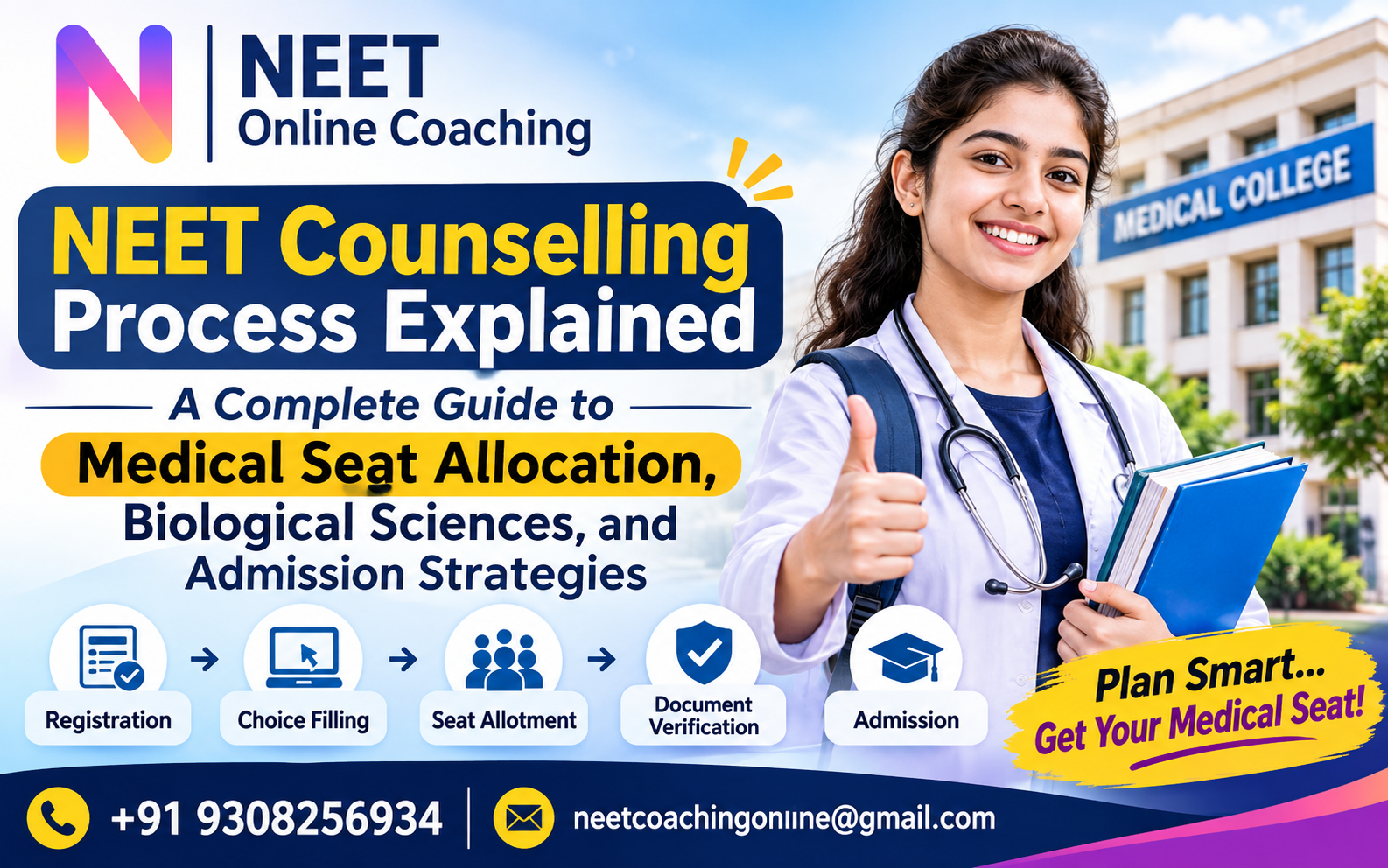
NEET Counselling Process Explained: A Complete Guide to Medical Seat Allocation, Biological Sciences, and Admission Stra
Every year, thousands of students appear for the National Eligibility cum Entrance Test (NEET UG) with the dream of pursuing a career in medicine. However, qualifying for the examination is only one part of the admission journey. Understanding the medical admission procedure, selecting suitable colleges, and completing the required formalities are equally important.
The NEET Counselling Process helps qualified candidates participate in medical seat allocation based on their NEET rank, eligibility, category, preferences, and available seats. Students who understand each stage can make more informed decisions and avoid common admission mistakes.
Whether you are targeting a government medical college, private institution, or deemed university, knowing how counselling works can make your admission journey more organized and less stressful.
What Is the NEET Counselling Process?
The NEET Counselling Process is the centralized or state-level admission procedure through which eligible NEET UG candidates are considered for available undergraduate medical and dental seats.
The counselling procedure generally includes online registration, choice filling, choice locking, seat allotment, document verification, and reporting to the allotted institution.
The Medical Counselling Committee (MCC), under the Directorate General of Health Services, conducts counselling for specified All India Quota seats and other designated institutions. State counselling authorities manage seats under their respective jurisdictions.
Students should understand that qualifying NEET does not automatically guarantee admission to a particular medical college. Admission depends on merit, applicable eligibility conditions, reservation policies, seat availability, and candidate preferences.
Understanding Different Types of NEET Counselling
There are different counselling categories through which candidates can seek admission to medical colleges.
1. All India Quota (AIQ) Counselling
All India Quota counselling provides eligible candidates an opportunity to compete for designated medical seats across participating states.
MCC conducts counselling for 15% AIQ seats in government medical and dental colleges, along with specified central institutions, AIIMS, JIPMER, and deemed universities under its jurisdiction.
2. State Quota Counselling
State counselling is conducted by the respective state authorities. It generally covers designated state quota seats in government medical colleges and applicable private institutions.
Candidates must carefully review state-specific domicile requirements, eligibility conditions, reservation rules, and admission notifications.
3. Private and Deemed University Counselling
Eligible candidates can also participate in counselling for designated private and deemed university seats. Their admission conditions, fee structures, and seat categories may differ.
The following comparison helps students understand the major counselling categories.
|
Counselling Category |
Responsible Authority |
Seat Category |
Important Considerations |
|
All India Quota |
MCC |
Designated AIQ seats |
NEET rank, preferences and reservation |
|
State Quota |
State counselling authority |
State government quota seats |
Domicile and state eligibility |
|
Deemed Universities |
MCC |
Designated deemed university seats |
Fees and institutional eligibility |
|
Private Medical Colleges |
Applicable counselling authority |
State or other designated private seats |
Fee structure and admission rules |
Step-by-Step NEET Counselling Process
Understanding the admission procedure beforehand helps candidates complete each stage correctly.
Step 1: Check NEET UG Results and Eligibility
After the declaration of NEET UG results, candidates should check their scorecards, All India Rank, qualifying status, and applicable eligibility conditions.
Step 2: Complete Online Registration
Candidates must register through the appropriate counselling portal. They need to provide the required information, verify their details, and pay the applicable registration fee and security deposit, wherever required.
Step 3: Fill in College Preferences
Choice filling allows students to select medical colleges and arrange them according to their preferences.
Candidates should research colleges based on previous-year closing ranks, location, available facilities, eligibility, and fee structure.
Step 4: Lock the Selected Choices
After reviewing their preferences, candidates should lock their choices within the notified deadline. They should retain a copy of the submitted choices for reference.
Step 5: Seat Allotment
The counselling authority processes candidate preferences according to merit, applicable reservation rules, eligibility, and available seats.
Candidates can check their allotment results through the official counselling portal.
Step 6: Reporting and Admission
Candidates allotted seats must follow the reporting instructions, complete document verification, fulfil admission requirements, and pay the prescribed institutional fees within the specified deadline.
How Medical Seat Allocation Works
Medical seat allocation is influenced by several factors rather than examination marks alone.
Important considerations include:
-
All India Rank: A candidate's position in the NEET merit list.
-
Category: Applicable reservation and category-specific rules.
-
College Preferences: The order in which candidates select institutions.
-
Seat Availability: Vacant seats in participating colleges.
-
Eligibility: Domicile, academic, and other applicable admission conditions.
For example, two students with similar NEET scores may receive different allotment outcomes because they belong to different categories, have different preferences, or participate in different counselling categories.
Students should also remember that previous-year closing ranks are only reference points. They do not guarantee admission in the current admission session.
Important Documents Required for NEET Counselling
Candidates should organize their documents before registration and reporting.
Commonly required documents include:
-
NEET UG admit card.
-
NEET UG scorecard or rank letter.
-
Class 10 certificate and marksheet.
-
Class 12 marksheet and passing certificate.
-
Valid photo identity proof.
-
Recent passport-size photographs.
-
Category certificate, if applicable.
-
Domicile certificate, where required.
-
Other certificates specified by the counselling authority.
Document requirements can differ across counselling categories and institutions. Always follow the latest official instructions.
Smart Strategies for Medical College Choice Filling
Choice filling is one of the most important stages of medical admission. A well-planned preference list can help candidates make better use of their available opportunities.
Consider these practical strategies:
Research previous-year cut-offs: Review opening and closing ranks to understand historical admission trends.
Check college facilities: Consider teaching hospitals, clinical exposure, infrastructure, laboratories, and academic facilities.
Evaluate financial requirements: Compare tuition fees, hostel charges, and other expenses before selecting private institutions.
Arrange preferences carefully: Place colleges according to genuine preference rather than relying entirely on assumptions about cut-offs.
Keep backup choices: Include suitable alternatives instead of selecting only highly competitive institutions.
Follow official notifications: Counselling schedules, eligibility conditions, and seat availability can change during the admission process.
Common Mistakes to Avoid During NEET Counselling
Students should avoid mistakes that can affect their admission opportunities.
-
Missing registration and choice-filling deadlines.
-
Entering incorrect personal or academic information.
-
Selecting colleges without checking eligibility.
-
Ignoring tuition fees and additional expenses.
-
Failing to lock preferences before the deadline.
-
Uploading incomplete or incorrect documents.
-
Missing reporting and admission deadlines.
-
Depending on unofficial cut-off predictions.
Careful preparation and regular checking of official notifications can help candidates avoid unnecessary complications.
How NEET Online Coaching Classes Support Medical Aspirants
Successful medical admission preparation begins long before counselling. Students need strong academic foundations in Physics, Chemistry, and Biology to perform well in NEET UG.
NEET Online Coaching supports aspirants through personalized one-on-one live online classes and subject-specific academic guidance.
Students can benefit from:
-
Experienced Physics, Chemistry, and Biology tutors.
-
NCERT-focused preparation for NEET UG.
-
Personalized learning strategies.
-
Individual doubt-solving support.
-
Conceptual explanations of difficult topics.
-
Flexible online learning schedules.
-
Performance-based academic guidance.
NEET Online coaching classes can help students strengthen their examination preparation and build confidence in challenging subjects.
It is important to understand that academic coaching supports NEET preparation, whereas official medical seat allocation and admission decisions are handled by the designated counselling authorities.
Conclusion
Understanding the NEET Counselling Process is essential for every medical aspirant planning to secure an undergraduate medical seat. From registration and choice filling to seat allotment and final admission, every stage requires careful attention and informed decisions.
Students should research medical colleges, understand their eligibility, prepare necessary documents, and follow official counselling notifications. Avoiding common mistakes and developing a realistic admission strategy can make the process more manageable.
Along with admission awareness, strong academic preparation remains the foundation of a successful NEET journey. NEET Online Coaching provides personalized one-on-one learning support to help aspirants strengthen their Physics, Chemistry, and Biology concepts.
With consistent preparation, informed decisions, and the right academic guidance, students can move forward confidently toward their dream of becoming medical professionals.
Frequently Asked Questions (FAQs)
1. When does the NEET Counselling Process begin after the NEET UG result?
The counselling schedule is announced by the respective authorities after the examination results. Candidates should regularly check official MCC and state counselling notifications for registration dates and deadlines.
2. What is the difference between All India Quota and State Quota counselling?
All India Quota counselling covers designated seats through MCC, while State Quota counselling is conducted by state authorities under their respective admission rules and eligibility requirements.
3. Can students participate in both AIQ and State Quota counselling?
Eligible candidates can generally participate in both counselling systems, provided they satisfy the applicable rules. They should carefully understand seat acceptance, resignation, and reporting conditions before making decisions.
4. Which documents are required for NEET UG counselling?
Common documents include the NEET admit card, scorecard, Class 10 and 12 certificates, identity proof, photographs, and applicable category or domicile certificates. Additional requirements may vary.
5. Does qualifying NEET guarantee admission to a government medical college?
No. Qualifying NEET makes a candidate eligible to participate in the applicable admission process, but a government medical college seat depends on rank, category, preferences, eligibility, and seat availability.
Online and home tutors for 2,700+ subjects. Book a free trial class today. tutormitra.com →