How an Online Indian History Tutor Helps Students Understand the Decline of the Mughal Empire and the Rise of Regional P
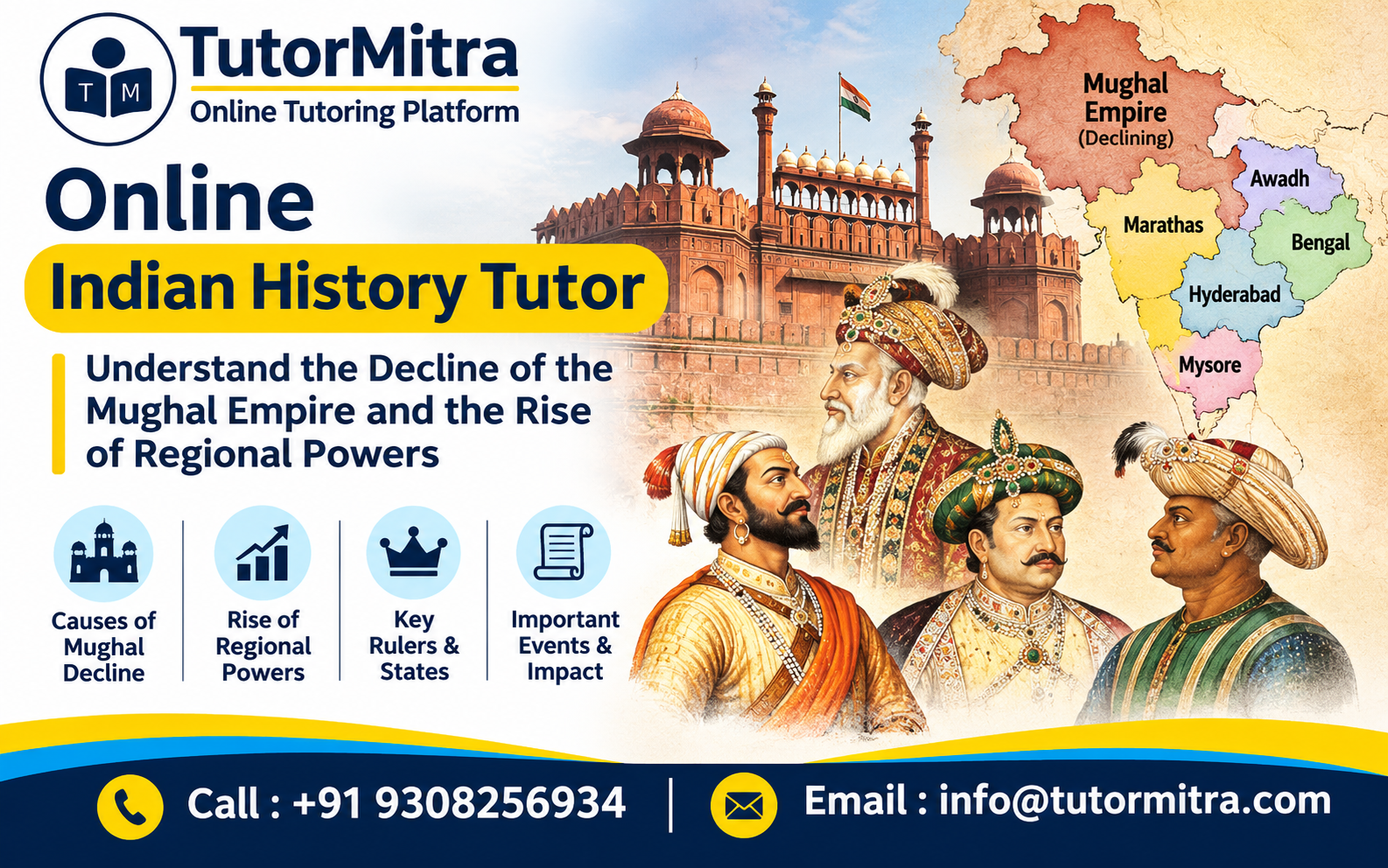
The eighteenth century was a major turning point in Indian history. The Mughal Empire, which had controlled extensive territories across the Indian subcontinent, gradually lost its political authority, creating opportunities for several regional powers to establish independent kingdoms and expand their influence.
Understanding this transition requires more than memorising the names of emperors, battles, and dynasties. Students must examine political instability, administrative weaknesses, economic challenges, military conflicts, and changing regional relationships.
An Online indian history Tutor can make this historical period easier to understand through chronological explanations, historical maps, comparative analysis, and examination-focused discussions. With personalised guidance, students can connect important events and understand how the decline of Mughal authority transformed India's political landscape.
Understanding the Decline of the Mughal Empire
The decline of the Mughal Empire was a gradual process that became increasingly visible after the death of Emperor Aurangzeb in 1707.
During Aurangzeb's reign, the empire expanded significantly, particularly into the Deccan. However, prolonged military campaigns placed considerable pressure on imperial finances and administrative resources.
After his death, succession disputes, conflicts among nobles, regional rebellions, and difficulties in maintaining central control weakened the empire further.
An experienced Online indian history Teacher helps students understand that the Mughal decline resulted from several interconnected developments rather than one isolated event.
Political Instability After Aurangzeb
Following Aurangzeb's death, the Mughal throne became the centre of repeated succession struggles.
Later emperors often depended heavily on powerful nobles and court factions. Political rivalries weakened decision-making and reduced the authority of the central administration.
Students should understand how these internal conflicts affected provincial governors, military commanders, and revenue officials.
Administrative and Economic Challenges
The Mughal administrative structure depended heavily on the mansabdari and jagirdari systems.
The jagirdari system involved assigning revenue rights from particular territories to officials in place of direct salary payments. Competition for productive jagirs and difficulties in maintaining an effective balance between imperial obligations and available revenue contributed to administrative tensions.
Land revenue collection, agrarian discontent, and regional resistance also affected imperial authority.
An Online indian history Tutor can explain these developments using simple examples of how declining central control affected the relationship between the emperor, nobles, zamindars, and provincial officials.
Major Events That Accelerated Mughal Decline
Several important events exposed the weakening Mughal Empire and accelerated political fragmentation.
Nadir Shah's Invasion in 1739
One of the most damaging events was the invasion of India by Persian ruler Nadir Shah in 1739.
His forces defeated the Mughal army at the Battle of Karnal. Nadir Shah subsequently entered Delhi, where widespread violence and looting took place.
The invasion resulted in enormous financial losses and severely damaged the prestige of the Mughal emperor.
Ahmad Shah Abdali's Invasions
Ahmad Shah Abdali, also known as Ahmad Shah Durrani, launched several invasions of northern India.
His campaigns further weakened Mughal authority in Punjab and surrounding regions.
The Third Battle of Panipat in 1761, fought between the Marathas and Abdali's forces, became another major turning point in eighteenth-century Indian history.
These events help students understand how external invasions and regional military competition contributed to the changing balance of political power.
The Rise of Regional Powers Across India
As Mughal authority weakened, several regional states developed greater political independence.
These powers followed different paths. Some emerged from former Mughal provinces, while others developed through military expansion, local resistance, and established regional leadership.
Successor States: Bengal, Awadh, and Hyderabad
Bengal, Awadh, and Hyderabad were important successor states that emerged from former Mughal provinces.
-
Bengal: Murshid Quli Khan strengthened provincial authority and established an increasingly autonomous administration. Bengal became an important centre of trade, agriculture, and textile production.
-
Awadh: Saadat Khan Burhan-ul-Mulk established the foundations of an increasingly independent regional state. Awadh developed significant political and economic influence in northern India.
-
Hyderabad: Nizam-ul-Mulk Asaf Jah established the Asaf Jahi dynasty in the Deccan and strengthened his control over regional administration.
An Online indian history Teacher can explain how these states retained several Mughal administrative practices while developing their own political identities.
The Rise of the Marathas and Sikhs
The Marathas emerged as a major political and military force under the leadership of Shivaji and later expanded through the efforts of the Peshwas.
Their influence spread across large parts of western, central, and northern India.
The Sikhs also developed increasing political strength in Punjab. Through organised military groups known as misls, Sikh leaders gradually established control over different territories.
The Jats, particularly under leaders such as Suraj Mal, developed an important regional power centred around Bharatpur.
Comparison of Major Regional Powers in Eighteenth-Century India
Understanding regional states becomes easier when students compare their geographical locations, important leaders, and political developments.
|
Regional power |
Important leader |
Major centre |
Historical significance |
|
Bengal |
Murshid Quli Khan |
Murshidabad |
Established strong provincial administration |
|
Awadh |
Saadat Khan |
Faizabad and Lucknow |
Developed an influential successor state |
|
Hyderabad |
Nizam-ul-Mulk Asaf Jah |
Hyderabad |
Established the Asaf Jahi dynasty |
|
Marathas |
Peshwas, including Baji Rao I |
Pune |
Expanded Maratha political influence |
|
Sikhs |
Ranjit Singh (later period) |
Punjab |
Established a powerful Sikh kingdom |
|
Jats |
Suraj Mal |
Bharatpur |
Strengthened regional authority in northern India |
|
Mysore |
Haidar Ali and Tipu Sultan |
Mysore and Seringapatam |
Developed a powerful southern kingdom |
This comparison helps students organise historical information and distinguish between different regional political developments.
How Historians Interpret the Decline of the Mughal Empire
One of the most interesting aspects of Indian history is that historians do not always agree on the causes and consequences of major political changes.
Earlier interpretations often emphasised weak rulers, administrative corruption, religious policies, and military challenges.
Other historians have examined the jagirdari crisis, agrarian tensions, regional economies, and changing relationships between the imperial centre and provincial authorities.
Modern historical research also highlights that the eighteenth century was not simply a period of complete economic and cultural decline. Some regional states experienced commercial development and continued established administrative and cultural traditions.
An Online indian history Tutor can introduce students to these different interpretations and help them develop balanced answers instead of relying on oversimplified explanations.
Effective Ways to Study Mughal Decline and Regional Powers
Students often find this chapter difficult because it includes numerous rulers, territories, political developments, and historical dates.
The following study techniques can make revision more effective:
-
Prepare a timeline: Record major events from Aurangzeb's death in 1707 to the important political developments of the eighteenth century.
-
Use historical maps: Identify Bengal, Awadh, Hyderabad, Maratha territories, Punjab, and Mysore.
-
Create cause-and-effect notes: Connect administrative weaknesses, military conflicts, and regional independence.
-
Compare regional rulers: Remember their important centres, political contributions, and historical significance.
-
Practise analytical questions: Explain why Mughal authority weakened and how regional powers benefited.
-
Revise through short summaries: Write important developments in your own words rather than memorising entire paragraphs.
These methods help students improve historical understanding, answer-writing skills, and examination performance.
Learn Indian History with Personalised Guidance from TutorMitra
Indian history becomes easier to understand when students receive clear explanations and opportunities to discuss historical developments.
TutorMitra connects learners with subject tutors who can provide personalised academic guidance in Indian history and related humanities subjects.
Students searching for an indian history Tutor Near Me can also explore online tutoring opportunities to receive individual attention and flexible learning support.
An Online indian history Tutor can help students with historical timelines, important dynasties, political developments, source-based questions, and analytical answer writing.
Whether you are studying for school examinations, competitive examinations, or advanced history courses, personalised lessons can help you strengthen your understanding of India's political and cultural past.
Conclusion
The decline of the Mughal Empire and the rise of regional powers represent one of the most significant transitions in Indian history. Political instability, administrative challenges, economic pressures, military conflicts, and regional ambitions gradually transformed the eighteenth-century political landscape.
Understanding this period requires students to connect historical events with their wider causes and consequences.
An Online indian history Tutor can simplify these developments through historical maps, timelines, comparative tables, and structured explanations.
With regular practice and personalised learning support from TutorMitra, students can develop stronger historical knowledge, improve analytical thinking, and approach Indian history examinations with greater confidence.
Frequently Asked Questions
1. Why did the Mughal Empire decline after Aurangzeb's death?
The Mughal Empire declined because of succession disputes, administrative weaknesses, conflicts among nobles, economic pressures, regional rebellions, and external invasions.
2. Which regional powers emerged after the decline of the Mughal Empire?
Important regional powers included Bengal, Awadh, Hyderabad, the Marathas, Sikhs, Jats, and Mysore.
3. What was the significance of Nadir Shah's invasion in 1739?
Nadir Shah's invasion exposed Mughal military weaknesses, resulted in the looting of Delhi, caused significant financial losses, and damaged the prestige of the Mughal emperor.
4. How did the Marathas become powerful during the eighteenth century?
The Marathas expanded their influence through military campaigns, effective leadership, and the political activities of the Peshwas, becoming one of the most influential powers in eighteenth-century India.
5. How can an Online Indian History Tutor help students prepare for examinations?
A tutor can explain historical events, create timelines, use maps, compare regional kingdoms, clarify difficult concepts, and provide practice with analytical and examination-style questions.
Online and home tutors for 2,700+ subjects. Book a free trial class today. tutormitra.com →