Moon: The Silent World That Governs Our Nights
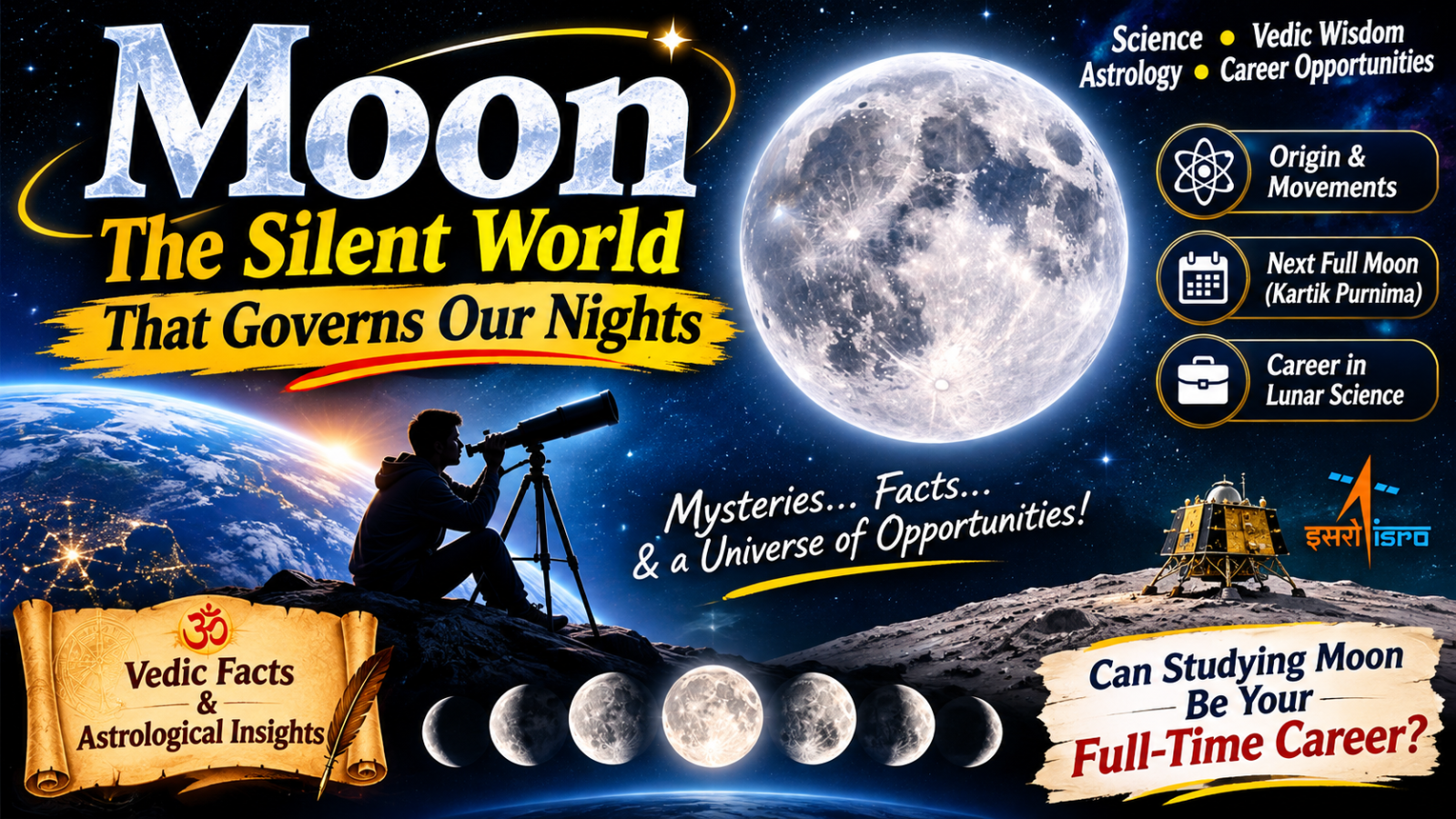
Moon: The Silent World That Governs Our Nights
An ancient companion of Earth, a witness to cosmic violence, and perhaps one of humanity's most promising scientific destinations.
There are few things more successful at attracting human attention than the Moon. Poets have borrowed its beauty, lovers have borrowed its light, astrologers have borrowed its authority, and scientists have borrowed neither. They have simply pointed their instruments towards it and started asking uncomfortable questions.
The Moon, however, has survived all these interpretations rather well.
1. What Exactly Is the Moon?
The Moon is Earth's only natural satellite. It is approximately 4.5 billion years old and has an average distance of 384,400 kilometres from Earth.
Its diameter is approximately 3,475 kilometres, making it about one-fourth the diameter of Earth. Its gravitational pull is roughly one-sixth of Earth's gravity.
Unlike the Sun, the Moon produces no visible light of its own. What we call moonlight is sunlight reflected from its rocky surface.
Its surface contains mountains, valleys, enormous impact craters, ancient volcanic plains and a layer of fine material called lunar regolith.
2. The Birth, Movement and Future of the Moon
The leading scientific explanation for the Moon's origin is the Giant Impact Hypothesis.
Approximately 4.5 billion years ago, a Mars-sized celestial body, commonly called Theia, collided with the young Earth. The enormous impact threw material into space. Over time, this material gathered together and formed the Moon.
The Moon has three important movements:
- Rotation: It spins on its own axis.
- Revolution: It travels around Earth.
- Orbital movement: Together with Earth, it travels around the Sun.
Interestingly, the Moon takes approximately 27.3 days to rotate once and complete one orbit around Earth. This synchronisation means we generally see the same hemisphere.
However, its phases repeat approximately every 29.5 days.
The Moon is also moving away from Earth at approximately 3.8 centimetres annually.
What about its lifespan?
The Moon has no known fixed expiration date. It will continue evolving for billions of years. Eventually, the Sun's transformation into a red giant will dramatically change the Earth-Moon system.
3. Scientific Facts Most People Don't Know
Here are some fascinating discoveries:
1. There is no permanently dark side. The far side receives sunlight just like the near side.
2. The Moon has water. Water molecules have been detected on its sunlit surface, while water ice exists in permanently shadowed polar craters.
3. It has moonquakes. Seismic activity occurs beneath its surface.
4. It has almost no atmosphere. Its extremely thin exosphere cannot protect astronauts from radiation or provide breathable air.
5. Its temperature is extreme. Surface temperatures can reach approximately 127°C in sunlight and fall to around -173°C in darkness.
6. It has no weather like Earth. Without substantial atmospheric protection, ancient impact craters can survive for billions of years.
7. We can see more than half of its surface over time. A phenomenon called libration allows us to observe slightly different portions of the Moon.
8. It influences Earth's tides. Its gravitational attraction plays an important role in the movement of ocean water.
Perhaps its greatest contribution is less visible: its gravitational influence helps stabilise Earth's axial tilt over long periods.
4. The Moon in Vedic Literature
Ancient Indian civilisation observed the Moon carefully, developing sophisticated systems for measuring time.
In Sanskrit, the Moon is called Chandra, Soma and Indu.
Vedic literature associates Soma with celestial and ritual significance. The Moon's movement also became central to traditional Indian timekeeping.
Some important concepts include:
- 27 Nakshatras: Lunar mansions marking divisions along the Moon's apparent path.
- Tithi: A lunar day calculated using the angular relationship between the Sun and Moon.
- Amavasya: New Moon.
- Purnima: Full Moon.
- Paksha: The waxing and waning halves of the lunar month.
These systems demonstrate the remarkable importance of celestial observation in ancient Indian astronomy.
5. Astrological Importance of the Moon
In Vedic astrology, Chandra is regarded as a significant planetary influence, although astronomically it is Earth's natural satellite.
Traditional Jyotish associates the Moon with:
- Mind and emotions.
- Motherhood and nurturing.
- Memory and imagination.
- Mental peace.
- Sensitivity and intuition.
The Moon occupies one zodiac sign for approximately two and a quarter days. Its position is also used to determine one's Janma Rashi and birth Nakshatra.
However, these are traditional astrological interpretations, not scientifically established effects on human personality or destiny.
6. Upcoming Full Moon: Kartik Purnima 2026
The next full Moon will occur on Tuesday, 24 November 2026, at approximately 8:24 PM IST.
It coincides with Kartik Purnima, an important occasion in Hindu traditions.
Kartik Purnima is associated with sacred bathing, prayers, charity, lighting lamps and the celebration of Dev Deepawali in certain traditions.
Scientifically, a full Moon occurs when the Moon appears fully illuminated from Earth because the Sun, Earth and Moon are approximately aligned, with Earth between the Sun and Moon.
The Moon does not suddenly become brighter because of religious observance. Its illumination is a predictable astronomical event.
7. Can Studying the Moon Become a Full-Time Career?
Absolutely. And this is perhaps the most exciting part of the story.
Lunar science is not merely about looking through telescopes. It involves physics, chemistry, mathematics, geology, computer science, engineering and data analysis.
Several career possibilities exist:
Career| What You Study
Astronomer| Celestial objects and observations
Planetary Scientist| Formation and evolution of planets and moons
Lunar Geologist| Moon rocks, minerals and craters
Astrophysicist| Physical processes in space
Aerospace Engineer| Spacecraft and lunar missions
Remote Sensing Scientist| Satellite images and lunar mapping
Space Data Scientist| Scientific data and computer modelling
How should students prepare?
A common academic route is:
Class 11–12 Science → BSc Physics/Geology/Mathematics → MSc in Astronomy, Astrophysics or Planetary Science → PhD and research.
Engineering students can pursue aerospace, electronics, mechanical engineering or computer science.
There are also opportunities in science communication, astronomy education, research journalism and scientific publishing for students from humanities backgrounds.
India's ISRO provides opportunities for scientists, engineers, technical assistants and research fellows. Its requirements vary according to the position.
Official information: https://www.isro.gov.in/Careers.html
8. The Moon Is Still Waiting to Be Discovered
Twelve human beings have walked on the Moon, all during NASA's Apollo missions between 1969 and 1972.
India's Chandrayaan-1 made an important contribution to lunar science by detecting evidence of water-related molecules on the lunar surface.
Future lunar exploration may help us understand the origin of Earth, the history of the Solar System and the possibility of establishing sustainable human activity beyond our planet.
The Moon has already given humanity calendars, scientific discoveries, inspiration and a better understanding of its own planet.
Yet, after approximately 4.5 billion years, it still has mysteries to offer.
Perhaps the greatest mistake a student can make is to believe that the Moon belongs exclusively to poets.
It belongs equally to those who are curious enough to study it.
Online and home tutors for 2,700+ subjects. Book a free trial class today. tutormitra.com →