mathematician neena gupta : The Indian Mathematician Who Solved a 70-Year-Old Mathematical Mystery
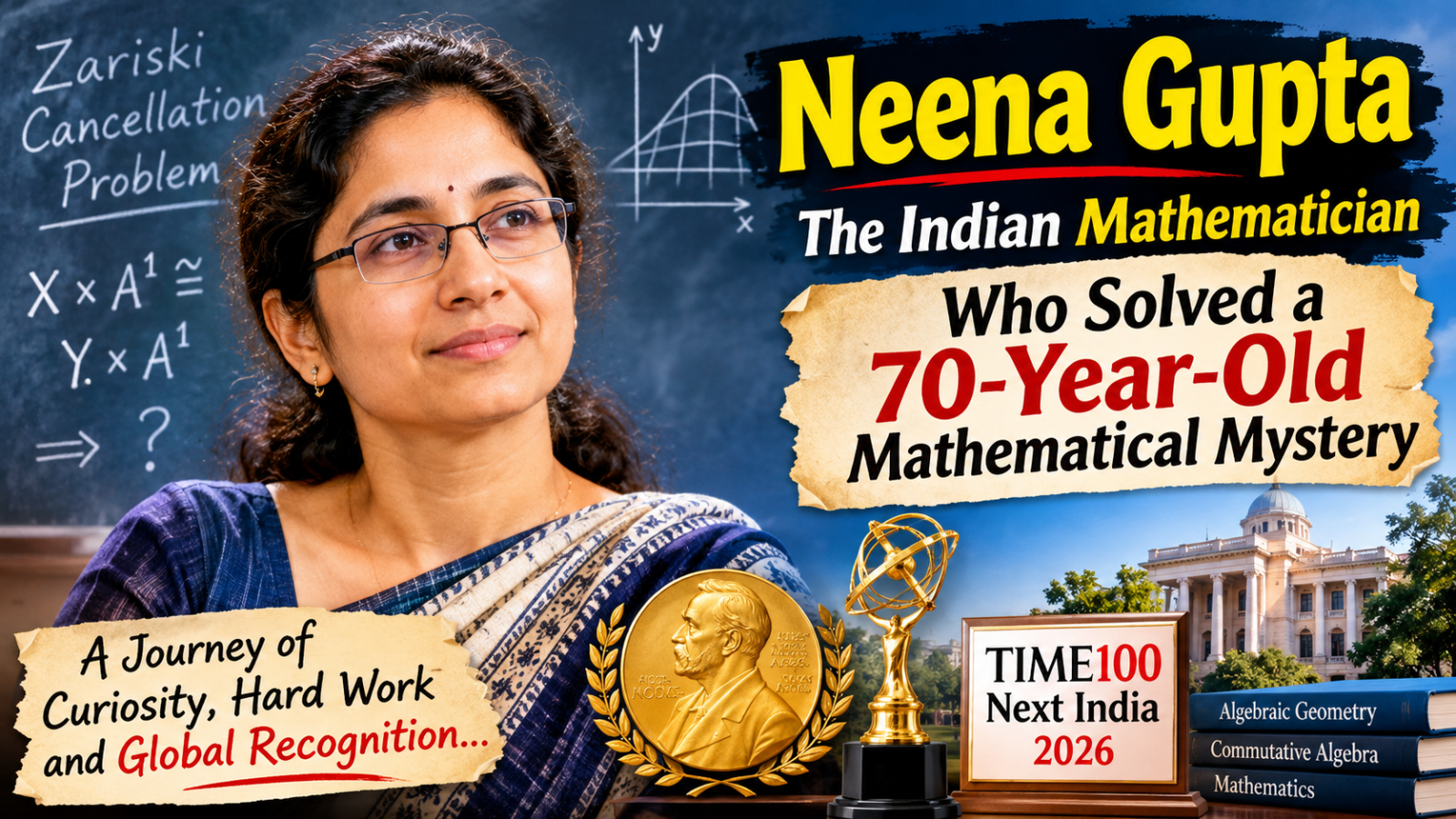
Neena Gupta: The Indian Mathematician Who Solved a 70-Year-Old Mathematical Mystery
Some people become famous because they act in films. Some because they play cricket. And some because they do something that even the brightest minds find difficult.
Neena Gupta belongs to the third category.
She is an Indian mathematician. Not a celebrity. Not a politician. But someone whose work made mathematicians around the world take notice.
And her story is interesting.
Because she worked on a mathematical problem that had remained unanswered for nearly 70 years.
Who Is Neena Gupta?
Neena Gupta was born on 24 November 1984 in Kolkata, West Bengal.
She was interested in mathematics and continued her studies in the same subject.
She completed her graduation in Mathematics from Bethune College, Kolkata, in 2006.
After that, she joined the Indian Statistical Institute (ISI), Kolkata.
She completed her master's degree in 2008 and received her PhD in 2011.
Her PhD supervisor was Professor Amartya Kumar Dutta.
Today, she works as a Professor in the Theoretical Statistics and Mathematics Unit at the Indian Statistical Institute, Kolkata.
A journey that started in Kolkata. And eventually reached the international mathematics community.
The 70-Year-Old Problem
Now comes the most interesting part of her story.
In 1949, a famous mathematician named Oscar Zariski introduced a mathematical problem.
It became known as the Zariski Cancellation Problem.
For many years, mathematicians tried to find an answer.
But the problem was not easy.
Let us understand it in simple English.
Imagine two mathematical objects. You add an extra dimension to both of them. Now they look exactly the same.
The question is: Were they also the same before adding that extra dimension?
It sounds simple.
But mathematics is not always as simple as it looks.
Many mathematicians studied this question. Years passed. Then decades.
In 2014, Neena Gupta made an important breakthrough.
She constructed a mathematical counterexample in positive characteristic, using a three-dimensional affine variety developed by Japanese mathematician Takanori Asanuma.
Her work showed that the cancellation property does not always hold.
In simple words, adding an extra mathematical dimension can sometimes hide important differences between two structures.
It was a major achievement.
And it brought her international recognition.
Awards and Achievements
Recognition followed her research.
Not all at once. But one achievement after another.
Here are some important awards and recognitions she received.
2014 – INSA Young Scientist Award
She received this award for her important contribution to mathematics.
2015 – Swarna Jayanti Fellowship
The Department of Science and Technology selected her for this prestigious research fellowship.
2019 – Shanti Swarup Bhatnagar Prize
One of India's most respected science awards. She received it in Mathematical Sciences.
2021 – Ramanujan Prize
This was another major international achievement. She became the third woman to receive the DST-ICTP-IMU Ramanujan Prize.
2022 – Nari Shakti Puraskar
She received India's highest civilian award for women from the President of India.
2022 – International Congress of Mathematicians
She was invited to speak in the section of Algebra and Algebraic and Complex Geometry.
2023 – TWAS-CAS Young Scientist Award for Frontier Science
Another recognition of her research work.
2024 – Infosys Prize
She received the Infosys Prize in Mathematical Sciences for her outstanding contribution to the Zariski Cancellation Problem.
2025 – Emmy Noether Lecture
She was selected to deliver the prestigious Emmy Noether Lecture.
2026 – TIME100 Next India
Her achievements received further attention when she was included in TIME's inaugural TIME100 Next India 2026 list.
A remarkable list for someone working in a subject that many students find difficult even at school.
What Does She Actually Study?
Neena Gupta does not simply solve ordinary school mathematics questions.
Her research is much more advanced.
She works mainly in two areas:
- Commutative Algebra.
- Affine Algebraic Geometry.
These subjects deal with mathematical structures, equations, numbers and their relationships.
She also works on topics connected with polynomial rings, affine spaces and algebraic properties.
It is difficult to explain all these things in a few lines.
But one thing is clear. Her research helps mathematicians understand some very deep questions about mathematics.
And that is what makes her work important.
A Scientist Working in India
There is another interesting thing about Neena Gupta.
She has built her research career in India.
At the Indian Statistical Institute, Kolkata.
Many young students believe that great scientific discoveries can happen only in America, Britain or other developed countries.
But her journey tells a different story.
India also has institutions where people are working on difficult scientific questions.
And sometimes, those people become internationally recognised.
No need for a dramatic story. No need for a big film scene.
Just a mathematician, her research and years of hard work.
Why Should Students Know About Her?
Most students study mathematics because they have examinations.
They learn formulas. Solve questions. Remember methods.
And sometimes, they start believing that mathematics is only about getting the correct answer.
But Neena Gupta's work tells us something different.
Mathematics is also about asking questions.
Sometimes, a question remains unanswered for years. Sometimes, even the most experienced people cannot find a solution.
And then somebody discovers a new way of looking at it.
That is research.
Students should understand that making mistakes does not mean that they cannot become good at something.
It is important to remain curious.
To ask questions. To read. To explore.
And most importantly, not to accept every idea without understanding it.
The Story Is Still Going On
Neena Gupta's journey is not just a story about awards.
Her achievements are important, but her contribution to mathematics is even more important.
From Bethune College to the Indian Statistical Institute. From a young mathematics student to an internationally recognised researcher.
A long journey.
And perhaps the most interesting part is that mathematics still has many unanswered questions.
Somewhere, another student may be sitting with a notebook, trying to understand a problem that nobody has solved yet.
Who knows?
Perhaps the next big discovery will also begin with a very simple question.
Just like the questions that made Neena Gupta famous.
And that is something worth remembering.
Online and home tutors for 2,700+ subjects. Book a free trial class today. tutormitra.com →