NEET Physics Preparation: A Step-by-Step Guide for Aspirants
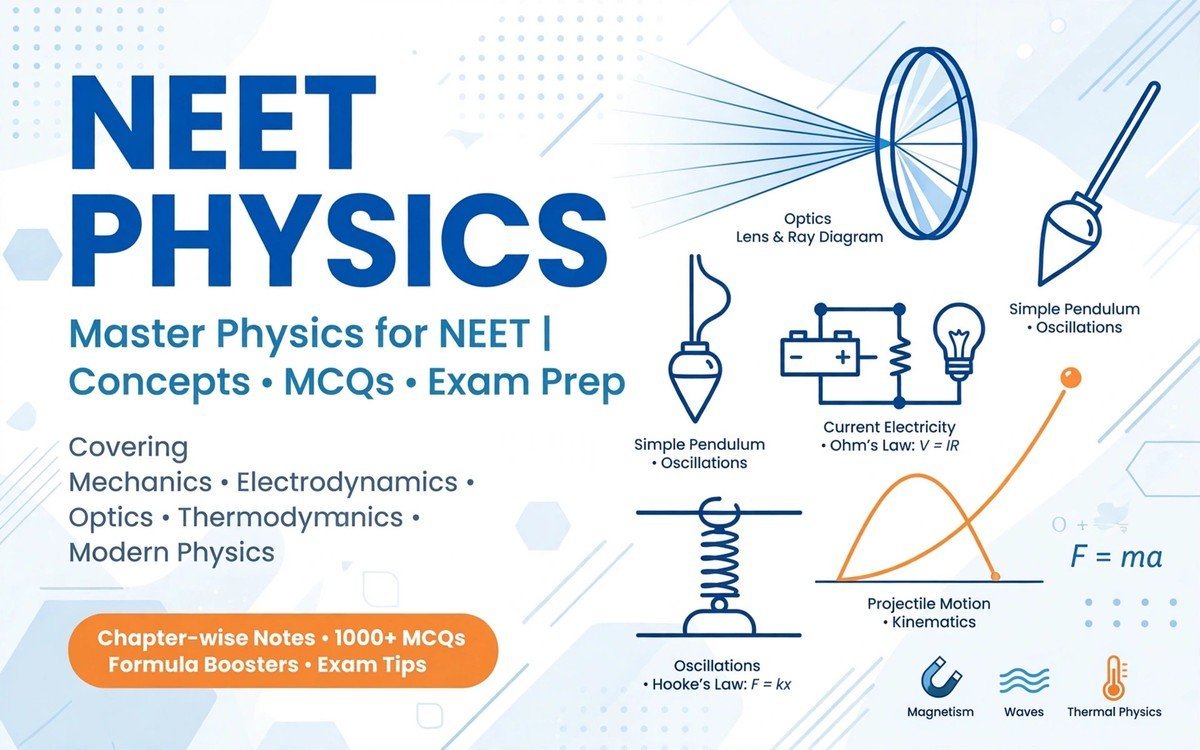
For many NEET aspirants, Physics is the subject that creates the most fear. Students who handle Biology comfortably often freeze when a long numerical appears on the screen. The good news is that NEET Physics is not random. It is based fully on the NCERT syllabus, it repeats concepts from previous years, and it rewards students who prepare in an organised way. This guide explains exactly how to study Physics for NEET, step by step.
Know the Exam Pattern First
Before opening any book, understand what you are preparing for. In NEET, Physics carries 45 questions worth 180 marks, which is one full quarter of the 720-mark paper. Every correct answer gives you +4, and every wrong answer takes away 1 mark, so blind guessing is costly. Roughly 46 percent of Physics questions come from Class 11 and 54 percent from Class 12, which means ignoring Class 11 is a mistake many students regret later. The syllabus covers 20 units from NCERT Class 11 and 12 Physics, and questions are a mix of theory-based and numerical-based, so both need equal practice.
High-Weightage Chapters to Prioritise
You must study everything, but you should study the heavy chapters first. Based on previous-year papers, these chapters regularly bring more questions:
|
Chapter |
Class |
Typical Questions |
|
Current Electricity |
12 |
3–5 |
|
Electrostatics (Charges, Potential and Capacitance) |
12 |
3–4 |
|
Laws of Motion |
11 |
Around 3 |
|
Thermodynamics |
11 |
Around 3 |
|
Semiconductor Electronics |
12 |
Around 3 |
|
Ray Optics and Optical Instruments |
12 |
2–3 |
|
System of Particles and Rotational Motion |
11 |
2–3 |
|
Atoms and Nuclei |
12 |
2–3 |
Weightage changes slightly every year, so use this table to decide your order of study, never as an excuse to skip chapters completely.
Step-by-Step Study Plan
Step 1: Build concepts from NCERT. Read each chapter slowly and understand the logic behind every formula instead of memorising it directly. If you know why a formula works, you will remember it under exam pressure.
Step 2: Make a formula notebook. Keep one thin notebook for all chapters. Write every formula with its conditions and units. Revise it for fifteen minutes every week.
Step 3: Finish NCERT examples and exercises. The solved examples show the exact method examiners expect. Many NEET questions are direct variations of these.
Step 4: Practise MCQs topic by topic. After finishing a chapter, solve topic-wise MCQs, then move to previous-year NEET questions from the last ten years. NEET repeats concepts, and PYQs show you the real difficulty level.
Step 5: Maintain an error notebook. Write down every question you get wrong and note why: concept gap, wrong formula, calculation slip, or silly mistake. Review this notebook before every mock test.
Step 6: Revise and take mock tests. Revise each chapter at least three times before the exam, and take one full mock test every week in the final months, strictly within the time limit.
How to Practise Numericals the Right Way
Most Physics marks are won or lost in numericals. Read the question and write down what is given and what is asked. Decide the concept first, then pick the formula. Convert all values into SI units before calculating. NEET is a pen-and-paper exam, so practise without a calculator and learn quick approximations. After solving, do a sanity check: does the size of the answer look realistic? Finally, time yourself. In the real exam you get roughly one minute per question, so your practice must build that speed gradually.
Common Mistakes to Avoid
- Reading theory again and again but never solving numericals.
- Ignoring Class 11 chapters and depending only on Class 12.
- Guessing blindly and losing marks to negative marking.
- Making formula notes once and never revising them.
- Taking mock tests but never analysing the errors afterwards.
Frequently Asked Questions
Is NCERT enough for NEET Physics?
NCERT is the base and is enough for theory and concepts, but you must add regular MCQ and previous-year question practice on top of it.
How many Physics questions should I practise daily?
Around 40 to 50 quality questions a day is a strong target once your concepts are clear. Quality and error analysis matter more than raw numbers.
Which class Physics carries more weightage?
Class 12 carries slightly more, around 54 percent, but Class 11 chapters like Laws of Motion and Thermodynamics are among the highest-scoring areas.
Can I prepare Physics without coaching?
Yes, if you are disciplined with NCERT, PYQs, and mock tests. If a chapter stays unclear after repeated attempts, a good tutor who explains one-on-one can save you weeks of confusion.
Final Thoughts
Physics improves slowly at first and then suddenly. Students who follow a simple cycle concept, formula, practice, errors, revision — find that the subject which scared them in Class 11 becomes their most reliable scoring section by exam day. Start early, stay consistent, and let previous-year questions be your guide. If you feel stuck on a topic, platforms like TutorMitra can connect you with Physics tutors who teach one-on-one and focus on exactly where you are weak.
Online and home tutors for 2,700+ subjects. Book a free trial class today. tutormitra.com →