Skill Development in India – Can Degrees Alone Guarantee Employment?
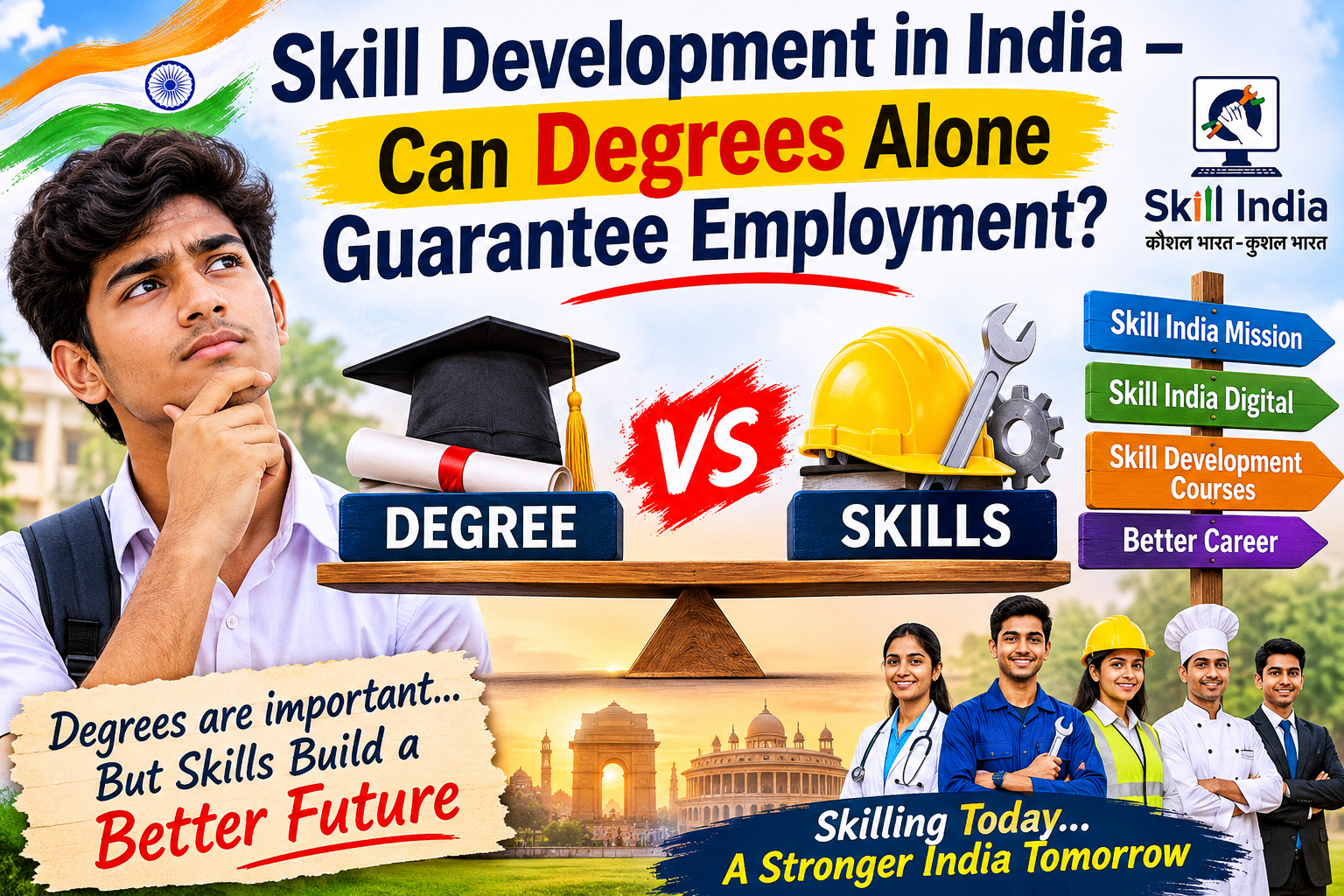
Skill Development in India – Can Degrees Alone Guarantee Employment?
A degree is a useful thing. It looks respectable on paper, sits nicely in a file and may please the family. But when an employer asks a young graduate to do a piece of work, the degree sometimes finds itself in an uncomfortable silence.
This is one of the important questions facing India today. Can degrees alone guarantee employment, or must education teach us how to work as well as how to pass examinations?
The Degree and the Real World
India has millions of young people who study hard, attend classes and earn qualifications. Yet a certificate does not always lead to a suitable job. Some graduates struggle to find work, while others accept jobs that have little connection with what they studied.
The problem is not that degrees are useless. Doctors need medical education. Teachers need professional training. Engineers require scientific knowledge. A strong academic foundation matters.
But knowing a subject and using that knowledge are two different things.
A student may understand English grammar but struggle to speak confidently in an interview. Another may study business but know little about managing a real customer. A third may learn computer theory without gaining enough practical experience.
This is where skill development in India becomes important. Education should give students knowledge, confidence and the ability to solve real problems.
Jharkhand Offers an Important Example
A recent report by ETEducation, published on November 5, 2026, discussed Jharkhand's proposed State Language Education Policy. Chief Minister Hemant Soren reviewed the draft and called for education that reflects the state's linguistic and cultural diversity. The proposal includes learning through the mother tongue alongside Hindi and English, spoken English classes before Class 12, and consideration of hockey as part of skill-based school education. The report also highlights digital learning.
The policy is still proposed, not a completed reform. Nevertheless, its direction raises an important question: should schools prepare students only for examinations, or also for the situations they will face outside the classroom?
Consider a student from a village in Jharkhand. The student may be intelligent and hardworking but speak a local language more comfortably than English. If education ignores that student's first language, learning can become unnecessarily difficult.
A better approach builds understanding through a familiar language while gradually developing Hindi, English and other useful abilities. Language should open doors, not become a wall.
Practical education should work in the same way. Students need opportunities to communicate, use technology, work with others and turn their knowledge into action.
What Is Skill Development?
Skill development means learning to perform a task well. It includes technical abilities, communication, problem-solving and the habits needed to work responsibly.
Some examples are:
- Digital skills: using computers, office software and online learning platforms.
- Communication: explaining ideas clearly, listening and writing effectively.
- Technical skills: learning practical tasks related to a particular profession.
- Entrepreneurship: understanding customers, costs, planning and business decisions.
- Teamwork: working with others, managing responsibilities and solving problems.
These abilities do not replace academic knowledge. They help people use it.
A student who learns mathematics and can also apply it to a real problem has gained something valuable. A student who studies science and learns to conduct experiments has moved beyond memorising facts.
That is the real purpose of skill development of India- helping education connect with life, work and the needs of society.
Government Initiatives and Digital Learning
The Government of India has introduced programmes to strengthen vocational training and improve access to skills. The Ministry of Skill Development and Entrepreneurship works in this area, while the National Skill Development Corporation supports skill-development initiatives and partnerships.
The Skill India Mission is another important part of this effort. Its wider aim is to help people acquire skills relevant to employment and economic activity.
Digital learning is also creating new opportunities. The Skill India Digital Hub provides an online route to explore skill-related learning and opportunities. Depending on the course, learners may find information about training, qualifications or other available services.
The growing interest in Skill India Digital Hub, mobile app development, backend development and React development in your supplied search-trend data suggests useful topics for future articles. However, rising search interest alone does not prove that these skills guarantee jobs.
Students should check course eligibility, fees, certificate recognition and current availability before enrolling. A certificate is most useful when it represents genuine learning and demonstrable ability.
Why the National Education Policy Matters
The National Education Policy (NEP) 2020 recognises the need to move beyond rote learning. It supports practical learning, critical thinking and vocational education. It also seeks to reduce the old belief that vocational courses are less valuable than academic studies.
This is an important change in thinking. A carpenter, electrician, computer programmer, farmer or skilled craftsperson uses knowledge that deserves respect.
Schools and colleges should help students discover their interests early. They should also give them opportunities to learn through projects, internships, experiments and practical work.
What Should Students Do?
Students do not need to wait until graduation to develop useful skills.
They can begin with a few simple steps:
1. Choose one useful skill. It could be spoken English, computer basics, coding, writing or a skill related to their chosen profession.
2. Practise regularly. Watching lessons is helpful, but doing the work is better.
3. Build a small portfolio. Keep examples of projects, writing, designs or other completed work.
4. Look for practical experience. Internships, apprenticeships and supervised projects can help students understand working life.
5. Keep learning. Technology and workplace needs change, so learning should continue after college.
Students can explore courses through the "Skill India Digital Hub" which lists learning opportunities, skill centres and employment-related services. Course availability and eligibility may vary, so check the details before applying.
Degrees Still Matter, but They Are Not Enough
It would be foolish to throw away the degree simply because practical skills are important. Qualifications can be essential for many professions and government jobs. Some careers require specific degrees, licences or examinations.
The sensible answer is to combine the right qualification with useful abilities, practical experience and a willingness to improve.
Employers need people who understand their work, communicate clearly and can learn when circumstances change. Students need opportunities to develop these qualities before they enter the job market.
Education Must Prepare Us for Life
The future of skill development in India should not be a contest between degrees and skills. Both have a place.
A degree can show what a person has studied. Practical work can show what that person can do. Character, curiosity and experience help turn both into something valuable.
India does not need to stop awarding degrees. It needs to make those degrees more meaningful.
After all, a certificate may help someone enter a room. What the person knows, can do and is willing to learn will help them make a place for themselves there.
Online and home tutors for 2,700+ subjects. Book a free trial class today. tutormitra.com →