How an Online Physical Chemistry Tutor Helps Students Master Chemical Kinetics, Reaction Mechanisms and Complex Rate Law
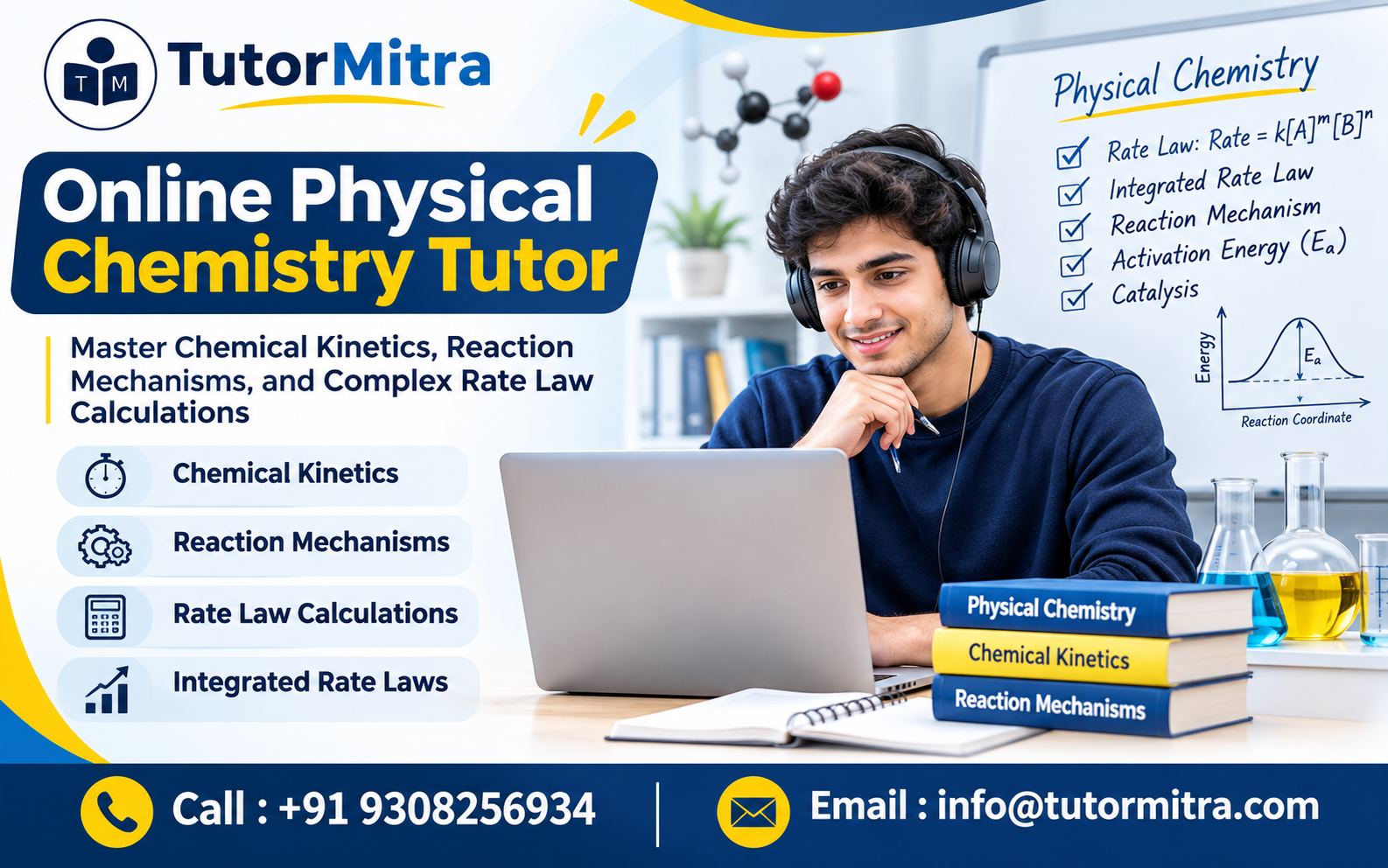
Physical chemistry often becomes challenging when students move from understanding theoretical concepts to solving complex numerical problems. Topics such as chemical kinetics, reaction mechanisms, activation energy, and rate law calculations require mathematical accuracy and a clear understanding of chemical processes.
An Online Physical Chemistry Tutor can help students understand these concepts through structured explanations, step-by-step numerical solutions, and personalised academic guidance. Instead of memorising equations, students learn how to interpret experimental data, identify reaction orders, understand molecular interactions, and apply mathematical principles to chemical problems.
Whether you are preparing for university examinations, advanced chemistry courses, or competitive examinations, individual tutoring can make difficult physical chemistry topics easier to approach.
Why Chemical Kinetics Is Challenging for Students
Chemical kinetics studies the speed of chemical reactions and the factors that influence reaction rates. Students must understand how concentration, temperature, catalysts, and reaction conditions affect chemical processes.
One common difficulty is distinguishing between reaction rate, reaction order, and the rate constant.
For example, a general rate law may be expressed as:
Rate = k[A]ᵐ[B]ⁿ
Here:
-
k represents the rate constant.
-
[A] and [B] represent reactant concentrations.
-
m and n represent experimentally determined reaction orders.
Students must understand that reaction orders are determined experimentally and cannot generally be predicted from the balanced overall chemical equation.
An Online physical chemistry Teacher can explain these relationships using experimental data, graphical representations, and practical numerical exercises.
How an Online Physical Chemistry Tutor Explains Complex Rate Law Calculations
Rate law calculations become easier when students understand the relationship between reactant concentration and reaction speed.
Consider the following rate law:
Rate = k[A]²[B]
If the concentration of A doubles while B remains constant, the reaction rate increases four times. If the concentration of B doubles while A remains constant, the rate doubles.
This happens because the concentration of A has a second-order dependence, while B has a first-order dependence.
A tutor can teach students to solve these questions using the initial rates method.
Understanding Integrated Rate Laws
Integrated rate laws explain how reactant concentrations change over time. They are particularly useful for calculating reaction duration, remaining concentration, and half-life.
The following table summarises the common integrated rate equations.
|
Reaction Order |
Integrated Rate Law |
Half-Life |
|
Zero Order |
[A]t = [A]₀ − kt |
t½ = [A]₀ / 2k |
|
First Order |
ln[A]t = ln[A]₀ − kt |
t½ = 0.693 / k |
|
Second Order |
1/[A]t = 1/[A]₀ + kt |
t½ = 1 / k[A]₀ |
An experienced tutor can demonstrate when to apply each equation and how to identify reaction order from concentration-time data.
For example, students can use a first-order integrated rate law to calculate the remaining concentration of a reactant after a specified period.
Understanding the correct equation is only the first step. Students must also pay attention to logarithms, units, significant figures, and conversions.
Understanding Reaction Mechanisms and Rate-Determining Steps
Chemical reactions do not always occur in a single step. Many reactions proceed through multiple elementary reactions involving intermediates.
A reaction mechanism describes the sequence of elementary steps through which reactants are converted into products.
For example:
Step 1: A + B ⇌ C
Step 2: C + D → Products
Here, C is an intermediate formed in the first step and consumed in the second step.
Students need to understand how elementary reactions combine to produce the overall chemical equation and how the slowest step can influence the overall reaction rate.
An online tutor can help students understand:
-
Elementary reactions and molecularity.
-
Reaction intermediates and catalysts.
-
Rate-determining steps.
-
Fast pre-equilibrium approximations.
-
Derivation of rate laws from proposed mechanisms.
-
Comparison of theoretical and experimentally observed rate laws.
Importantly, a proposed mechanism must be consistent with experimental evidence. The balanced overall reaction alone does not establish the actual reaction pathway.
How Personalised Online Lessons Improve Physical Chemistry Learning
Physical chemistry combines chemistry, mathematics, and logical reasoning. Students who struggle with one part of the subject may find it difficult to solve advanced problems.
Personalised tutoring helps identify these gaps and organise lessons around individual learning requirements.
For example, a student who understands chemical kinetics theory but struggles with numerical questions may need additional practice involving logarithmic calculations, reaction orders, and rate constants.
Similarly, a student struggling with reaction mechanisms may benefit from visual explanations and step-by-step derivations.
A physical chemistry tutor can support learning through:
-
Concept-based explanations of difficult topics.
-
Step-by-step numerical problem-solving.
-
Practice with examination-style questions.
-
Graph interpretation and experimental data analysis.
-
Individual doubt resolution.
-
Regular revision and progress assessment.
This approach encourages students to understand the reasoning behind equations rather than simply memorising formulas.
Important Skills to Develop for Advanced Chemical Kinetics
Students aiming to improve their physical chemistry performance should develop several connected skills.
Mathematical accuracy: Practice logarithms, algebraic rearrangements, proportional relationships, and scientific notation.
Experimental data interpretation: Learn to compare initial reaction rates and determine the orders of individual reactants.
Graphical analysis: Understand concentration-time, logarithmic concentration-time, and reciprocal concentration-time plots.
Mechanism evaluation: Identify intermediates, elementary steps, and rate-determining processes.
Unit management: Understand the units of rate constants for different overall reaction orders.
For example, the units of a second-order rate constant are generally M⁻¹s⁻¹ when concentration is expressed in molarity and time in seconds.
How to Choose the Right Physical Chemistry Tutor Near Me
Finding a suitable physical chemistry Tutor Near Me can be important for students who need additional academic support. However, geographical proximity is not the only factor to consider. Online tutoring also allows students to explore teachers beyond their immediate location.
Before selecting a tutor, consider the following:
-
Subject expertise: Look for a strong understanding of chemical kinetics, thermodynamics, reaction mechanisms, and physical chemistry calculations.
-
Teaching experience: Consider experience teaching students at your academic level.
-
Problem-solving approach: Choose someone who explains calculations rather than simply providing answers.
-
Personalised lessons: Ensure that teaching methods address your specific learning difficulties.
-
Communication skills: Complex mathematical and chemical concepts should be explained clearly.
-
Practice materials: Regular numerical exercises and revision questions can support better preparation.
Learn Physical Chemistry with Personalised Guidance from TutorMitra
Students looking for additional academic support can explore TutorMitra, an online tutoring platform connecting learners with tutors across different academic subjects.
Whether you need help understanding chemical kinetics, practising complex rate law calculations, or analysing reaction mechanisms, personalised tutoring can provide a more structured learning experience.
TutorMitra focuses on individual learning requirements, helping students explore suitable tutors according to their academic goals and subject needs.
If you are searching for an Online Physical Chemistry Tutor, exploring TutorMitra's tutoring options can be a useful starting point for finding relevant academic guidance.
Conclusion
Mastering physical chemistry requires more than memorising equations. Students need to understand experimental observations, mathematical relationships, reaction pathways, and the principles governing chemical processes.
An Online Physical Chemistry Tutor can help learners approach difficult topics through structured explanations, numerical practice, and individual feedback.
By developing a strong foundation in chemical kinetics, integrated rate laws, and reaction mechanisms, students can improve their problem-solving abilities and approach advanced physical chemistry questions with greater confidence.
Frequently Asked Questions
1. What does an online physical chemistry tutor teach?
An online physical chemistry tutor can teach chemical kinetics, thermodynamics, reaction mechanisms, rate laws, equilibrium, electrochemistry, and other physical chemistry topics according to the student's academic requirements.
2. How can I understand chemical kinetics numerical problems more easily?
Start by identifying the given information, determining the reaction order, selecting the appropriate rate equation, and checking the units. Regular practice with different numerical problems helps strengthen understanding.
3. What is the difference between differential and integrated rate laws?
Differential rate laws describe how reaction rates depend on reactant concentrations. Integrated rate laws describe how reactant concentrations change over time.
4. Can an online physical chemistry teacher help with reaction mechanisms?
Yes. A suitable teacher can explain elementary steps, intermediates, molecularity, rate-determining steps, and the relationship between reaction mechanisms and experimentally determined rate laws.
5. How do I find a physical chemistry tutor near me?
You can explore online tutoring platforms such as TutorMitra to find tutors who match your subject requirements, academic level, and preferred learning approach.
Online and home tutors for 2,700+ subjects. Book a free trial class today. tutormitra.com →