Triple Star System: The Mysterious World Where Three Stars Share One Cosmic Family
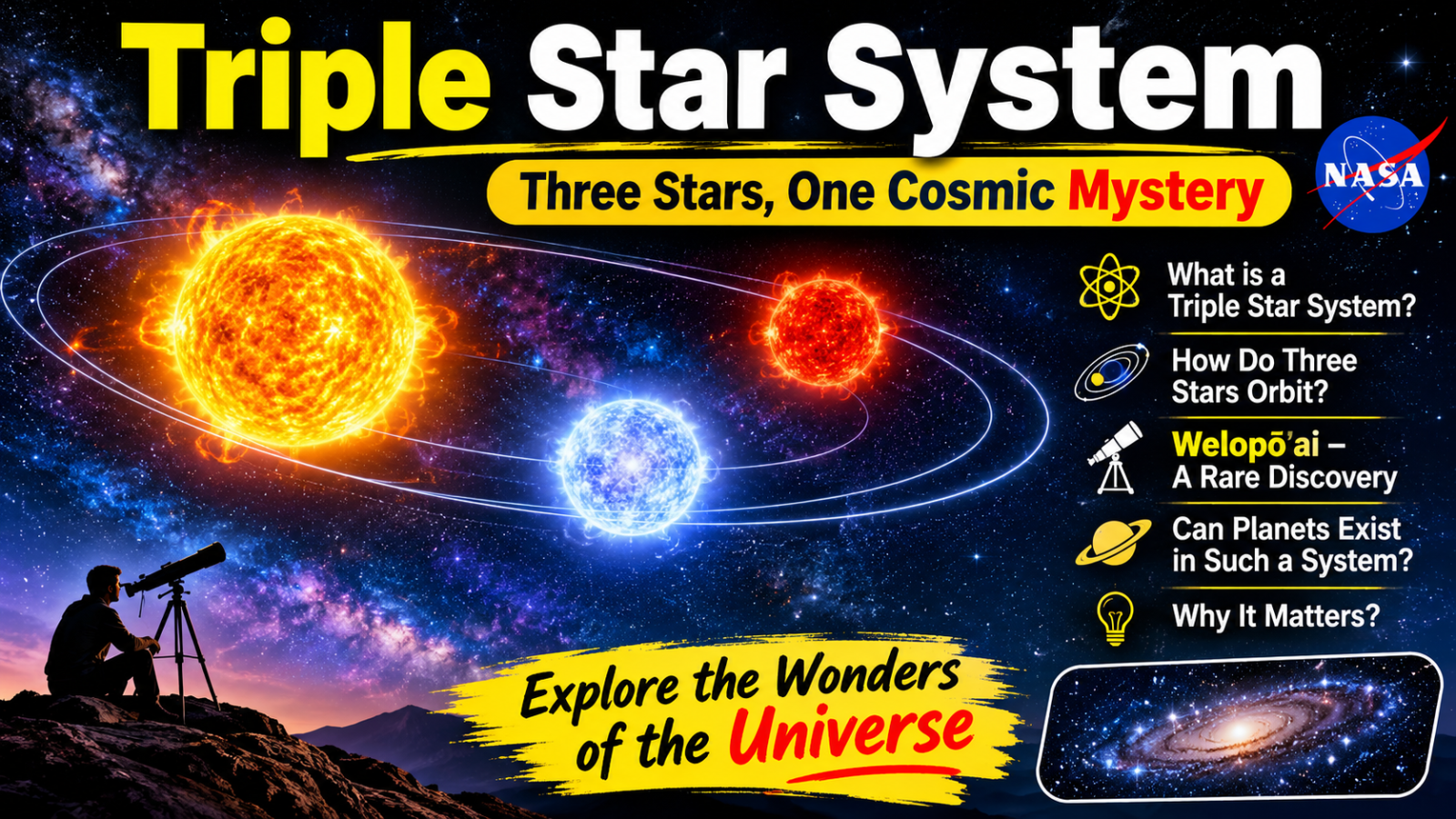
Imagine looking at the night sky and finding not one Sun, but three. Three enormous stars, sharing the same gravitational neighbourhood. Moving through darkness, following invisible paths. Sometimes close, sometimes separated by enormous distances.
It sounds like something from a science-fiction novel.
But nature has already written this story.
Astronomers call such arrangements triple star systems. And a remarkable discovery reported in November 2026, involving three stars just 28 light-years from Earth, has raised an interesting question: how can three stars survive together when their gravitational interactions are so complicated?
To understand this strange family of stars, we must begin with the basics.
What Is a Triple Star System?
A triple star system is a group of three stars connected by gravity. They move around a common centre of mass, known as the barycentre.
Unlike our Solar System, where planets orbit one central star, a triple star system contains three stars influencing one another through gravity.
These stars are not necessarily equal in size, brightness or mass.
One may be enormous. Another comparatively small. The third could be a faint red dwarf.
NASA explains that multiple-star systems can contain two, three or even more stars. Binary systems have two stars, while triple systems have three.
And here comes the interesting part. Three stars do not necessarily move around one another randomly.
There are patterns.
How Do Three Stars Orbit Each Other?
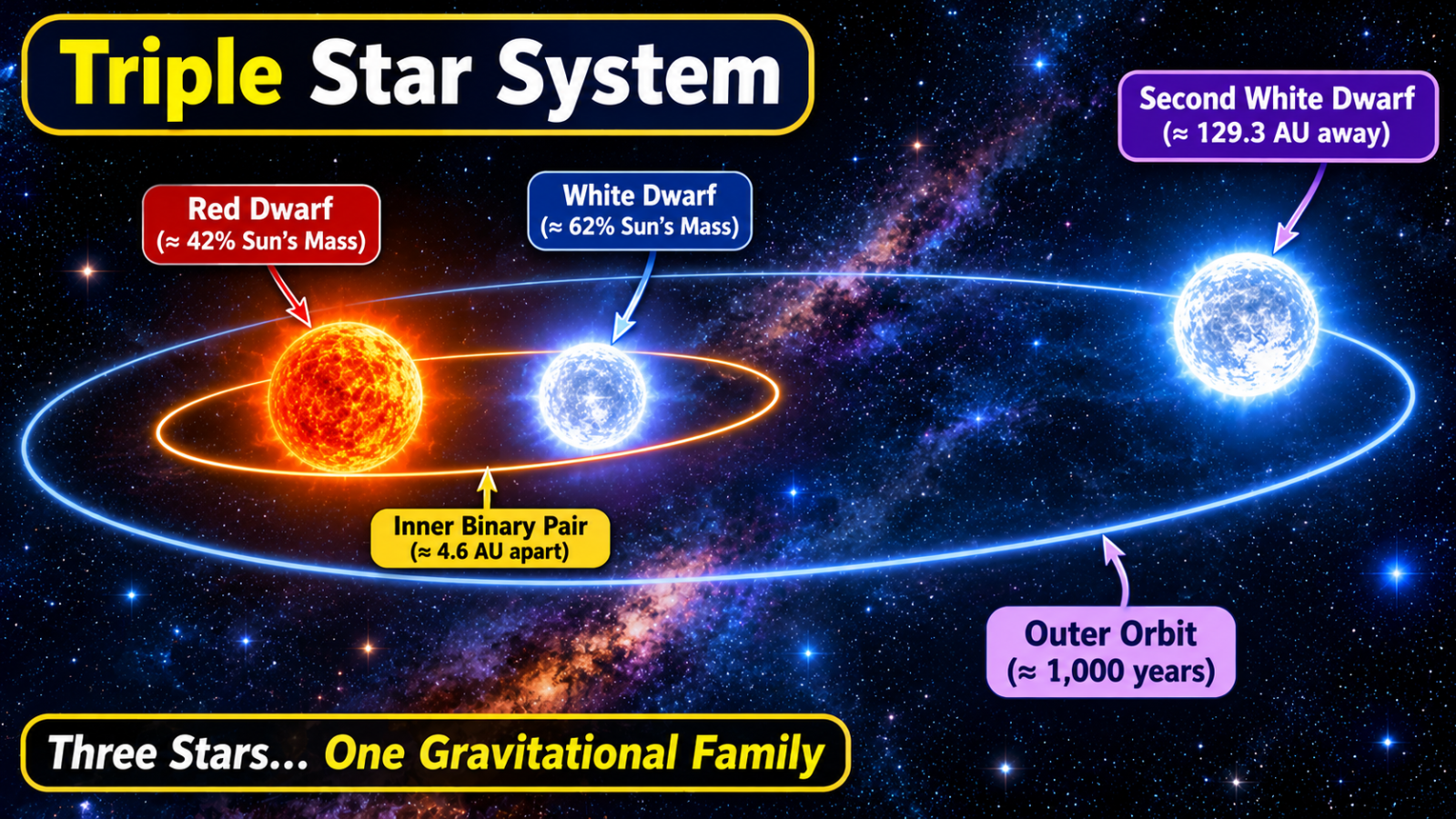
The most common stable arrangement is called a hierarchical triple star system.
It works rather simply.
- Two stars form a close binary pair.
- These two stars orbit their common centre of mass.
- A third star travels around the inner pair from a much greater distance.
In this arrangement, the outer star generally experiences the inner pair somewhat like a single gravitational object.
This separation helps prevent the three stars from constantly disturbing one another.
However, not every triple system follows exactly the same arrangement. Some have unusual orbital shapes, different inclinations and complicated gravitational interactions.
The distances, masses and orbital eccentricities all matter.
Why Are Triple Star Systems So Difficult to Understand?
The answer lies in something called the three-body problem.
When two objects interact through gravity, scientists can calculate their movements with mathematical precision under ideal conditions.
But introduce a third object.
Suddenly, the calculations become much more complicated.
Each star pulls the other two. Their movements change according to their masses, distances and orbital positions.
A small change in the beginning can produce a very different result over millions or billions of years.
Does this mean triple star systems are unstable?
No.
Hierarchical triple systems can remain stable for extremely long periods if their orbital arrangement is suitable. Scientists use computer simulations and gravitational equations to study their evolution.
There is also a fascinating phenomenon called the Lidov–Kozai mechanism. Under certain conditions, the gravitational influence of a distant third star can gradually change the inclination and eccentricity of the inner binary's orbit.
In simple words, the third star can reshape the movement of the other two without coming particularly close.
Welopō’ai: The Triple Star System That Puzzles Scientists
On November 23, 2026, Space.com reported an extraordinary triple star system called Welopō’ai, located approximately 28 light-years from Earth.
Its discovery began with a search for planets.
Astronomers led by Étienne Artigau were studying a red dwarf using the SPIRou instrument. They noticed an unusually large movement in the star.
It was not an ordinary planet causing the movement.
Further observations using the Gemini North telescope revealed something surprising: a white dwarf.
And there was another white dwarf farther away.
The system contains:
- A red dwarf with approximately 42% of the Sun's mass.
- An inner white dwarf with approximately 62% of the Sun's mass, separated from the red dwarf by around 4.6 astronomical units.
- A second white dwarf, approximately 129.3 astronomical units from the inner pair.
The distant white dwarf takes roughly 1,000 years to complete one orbit around the inner pair.
But what makes this discovery extraordinary?
The two white dwarfs were once ordinary stars, broadly similar to our Sun.
As they aged, they expanded into red giants and eventually lost their outer layers. Their remaining cores became white dwarfs.
The red dwarf survived this entire evolutionary history.
Scientists expected the expansion of the older stars to disturb the red dwarf's orbit, possibly even destroying the original arrangement.
Yet the system exists.
How?
Nobody has a complete answer.
That is why Welopō’ai is so valuable for studying stellar evolution.
What Is a White Dwarf?
A white dwarf is the extremely dense leftover core of a star that has completed its normal life.
It is not a newly born star.
It no longer produces energy through ordinary hydrogen fusion in its core. Instead, it gradually loses its stored heat.
Despite having a mass comparable to the Sun, a typical white dwarf is approximately the size of Earth.
Its matter is supported against further gravitational collapse by electron degeneracy pressure, a quantum mechanical effect.
This makes white dwarfs important laboratories for understanding extreme physics.
Can Planets Exist in a Triple Star System?
Yes.
And this is perhaps one of the most exciting possibilities.
NASA identifies the Alpha Centauri system as our nearest stellar neighbour. It contains three stars: Alpha Centauri A, Alpha Centauri B and Proxima Centauri.
Proxima Centauri has at least one known planet.
Planets can survive in multiple-star systems when their orbits occupy suitable stable regions.
Some planets orbit one star while another star remains far away. Others can orbit two stars together.
However, not every orbital arrangement is suitable for long-term planetary stability.
How Do Astronomers Discover Triple Star Systems?
Astronomers cannot always distinguish three stars simply by looking through a telescope.
Sometimes one star is too faint. Sometimes two stars appear almost like one object.
Scientists use several techniques:
Radial velocity: Measures the movement of a star towards or away from Earth using changes in its light.
Astrometry: Measures the tiny changes in a star's position.
Spectroscopy: Studies starlight to understand a star's temperature, composition and movement.
Direct imaging: Uses powerful telescopes to observe individual stellar companions.
Computer simulations: Help reconstruct the possible history and future movements of multiple stars.
Welopō’ai is an excellent example of how searching for one thing can lead to another discovery entirely.
Why Should We Study Triple Star Systems?
Because they help us understand how stars are born, how they age and how gravity works.
They also help scientists investigate the formation of white dwarfs, the survival of planets and the long-term evolution of stellar systems.
A triple star system is not simply three suns sharing one address.
It is a natural experiment taking place on a scale that humans can hardly imagine.
And perhaps the most beautiful lesson is this, even after studying the universe for centuries, we are still discovering things that challenge our understanding.
Welopō’ai is one such reminder.
Three stars. One gravitational family. And a mystery waiting to be solved.
Online and home tutors for 2,700+ subjects. Book a free trial class today. tutormitra.com →